Red light therapy for wrinkles: does it work, and which LED mask to buy
Every listicle names the same handful of masks and quotes a dermatologist who likes one of them. What they skip is the actual trial behind the claim, the fact that its own light-dose math was challenged in print, and what a $37 mask measures next to a $400 one when someone points a spectrometer at it instead of a marketing page.
Disclosure: the HigherDOSE mask link in this guide is an affiliate link, so Agewell may earn a commission if you buy. It did not change the verdict: Omnilux remains the most independently cited pick, and HigherDOSE is included as a lower-price cleared option with a clearly labeled brand-stated output. How affiliate links work.
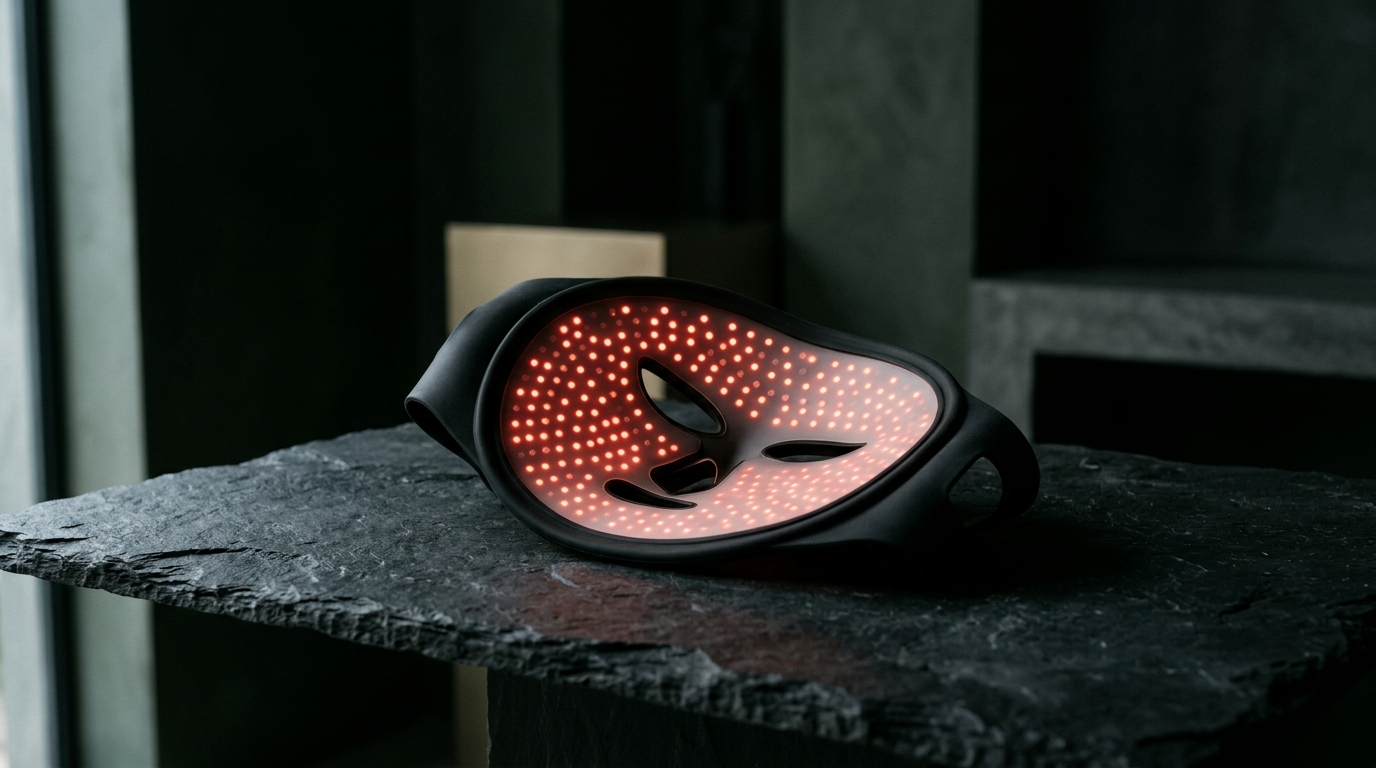
Editorial image, not a product photo. See the product cards below for the actual devices.
QUALIFY$30-4709 min
Answer-first
Red and amber LED masks are FDA-cleared under the "light-based OTC wrinkle reduction" category, and one sham-controlled trial found a real 31.6% drop in periocular wrinkle volume, but a published critique challenges that same trial’s reported light dose, a $37 unbranded mask measured near-zero therapeutic output in independent spectrometer testing, and the credible cleared options today start around $349.
Agewell verdict
Qualify before buying: try a retinoid first since it is cheaper and has the deeper evidence base, and only add an LED mask if you will actually use it three to five times a week for months. If you do, buy one of the five FDA-cleared masks below, not a sub-$100 unbranded one; none of the cheap ones have any independent measurement behind them, and the one that has been tested measured close to zero.
FDA-cleared (510(k) K191629, product code OHS), 633nm/830nm, 132 LEDs, 10-minute sessions, flexible silicone. The mask independent editorial reviews and dermatologist quotes cite most often, and the one with the longest clinical-research trail behind the brand name.
FDA-cleared (510(k) K241933), with 132 diodes at 630/830nm, 10- or 20-minute sessions and a 120-day return window. HigherDOSE states 50 mW/cm² total irradiance, but no independent spectrometer result or head-to-head wrinkle trial was found, so the lower price does not make it the evidence leader.
Affiliate link. We may earn a commission; the relationship does not change this pick or its caveats.
FDA-cleared (510(k) K252983), 320 LEDs across four wavelengths (605/630/660/830nm), 3-minute sessions. Solawave states 65 mW/cm² and 11.7 J/cm² per session on its own product page; that number is not independently spectrometer-verified, so treat it as a brand claim, not a measured fact.
FDA-cleared (510(k) K250966, decided mid-2025), 236 LEDs at 633/830/1072nm, 10-minute sessions 3-5x/week. It is the only option here with a deep near-infrared channel, at the highest price in this set.
FDA-cleared, 100 red LEDs (630/605nm plus 880nm near-infrared) and 62 blue LEDs (415nm) in one 3-minute mask, one-year warranty, 30-day return. The only mask here that also targets acne; fewer red/NIR LEDs than most of the shortlist for the same or higher price if wrinkles are the only target.
The one independent spectrometer test found of this price tier measured about 0.1 mW/cm² total output, roughly what you would get sitting in front of a laptop screen, against 65 mW/cm² and up claimed by the cleared masks above. No FDA clearance and no independent measurement to the contrary has turned up in this category yet.
Start with the retinoid, not the mask
A $400 LED mask is not the first move against wrinkles. The American Academy of Dermatology recommends a topical retinoid as an established first-line treatment for fine lines and wrinkles, backed by decades of trials, at a fraction of the price of any mask on this page. If you have not tried a retinoid and daily sunscreen yet, that is the higher-evidence, lower-cost place to start.
That does not make an LED mask pointless. It makes it an adjunct question, not a replacement question: does adding light therapy to a routine that already includes sun protection and, ideally, a retinoid buy you anything real. The evidence below says yes, within limits, and with one important asterisk the sales pages leave out.
Does red light actually reduce wrinkles?
The strongest single piece of evidence is a sham-controlled, split-face trial of 137 women aged 40 to 65: ten sessions over four weeks of 660nm red or 590nm amber light at 3.8 J/cm² on one side of the face, sham light on the other. Periocular wrinkle volume dropped 31.6% on the red-treated side and 29.9% on the amber side, measured by 3D imaging equipment, not self-report. Skin hydration and elasticity did not improve, and quality-of-life scores did.
Here is the asterisk almost no buying guide mentions: a published response to that same trial recalculated the light dose from the paper’s own stated parameters and got a materially different number than the authors reported, roughly 2.7-3.9 mW/cm² against the paper’s stated 6.4 mW/cm². That does not erase the measured wrinkle-volume result, but it means the trial’s own dosimetry was contested in the same journal, in print, which is worth knowing before you treat "31.6%" as a settled number rather than one independently-scrutinized data point.
How it works, and the older, industry-tied study
The proposed mechanism is photobiomodulation: red and near-infrared light is absorbed by mitochondrial cytochrome c oxidase in skin fibroblasts, which is thought to increase collagen and elastin production over repeated sessions. The American Academy of Dermatology's own summary is blunter than most product pages: "we still do not fully understand the effects of red light on the skin," and it notes many existing studies are small and some are funded by the device manufacturers being studied.
The earlier large trial in this space illustrates that caveat directly. A 2014 controlled study of 136 subjects found a measurable collagen-density increase from red and near-infrared light, and one of its two authors is affiliated with a light-therapy device manufacturer. That is a disclosed conflict, not evidence of fraud, but it is exactly the kind of practitioner-adjacent study Agewell treats as a hypothesis in need of independent confirmation, not proof on its own.
What "FDA-cleared" actually promises here
Every mask on this page carries the same regulatory line, and it means less than the marketing implies. These devices clear under FDA product code OHS, "Light Based Over The Counter Wrinkle Reduction," a 510(k) pathway that requires showing substantial equivalence to a device already on the market. The AAD states this plainly: FDA clearance tells you a device is considered safe, not that it works, and terms like "FDA-approved" carry no real meaning for a device in this category.
What that means for a buyer: clearance is a real safety floor, and it rules out the most fly-by-night hardware, but it does not rank the four masks below against each other, and it certainly does not rank them against a sub-$50 mask that never bothered to seek clearance at all.
The parameters that matter, and the cheap-mask trap
The dose math is the same joules-per-square-centimetre calculation covered in Agewell's red light dosing guide: irradiance in mW/cm², multiplied by seconds of exposure, divided by 1,000. Solawave states 65 mW/cm² and 11.7 J/cm² for a 3-minute session on its own product page. That is a brand-stated number, not an independently spectrometer-verified one, the same caveat Agewell applies to every red light panel maker.
The one independent test to actually put a spectrometer on a cheap mask found a $37 unbranded Amazon device measuring about 0.1 mW/cm² overall, against a reviewer-stated 5-15 mW/cm² floor for an "adequate" mask and 70-90 mW/cm² for a proper red light panel at six inches. That is not a rounding error; it is the difference between a therapeutic dose and pointing a nightlight at your face. Until a comparably rigorous independent test turns up a cheap mask that clears a real dose, the honest buying rule is: skip anything under roughly $100 in this category.
Which mask to buy
Five masks now have a genuine FDA 510(k) record behind them in this shortlist: Omnilux Contour Face ($395, the most independently cited and clinically referenced), HigherDOSE Red Light Face Mask ($349, the lowest price and a brand-stated 50 mW/cm²), Solawave Wrinkle Retreat Pro ($399, the most LEDs and the shortest 3-minute session), CurrentBody Skin LED Mask Series 2 ($470, the only one with a deep near-infrared channel), and Dr. Dennis Gross DRx SpectraLite FaceWare Pro ($455, the only one that doubles as an acne mask via a blue-light mode).
None of the five has a head-to-head trial proving it outperforms the others on wrinkles specifically. Pick on the axis that actually matters for you: Omnilux for the deepest independent citation trail, HigherDOSE for the lowest cleared entry price, Solawave for session time and LED count, CurrentBody for the deep near-infrared channel, and Dr. Dennis Gross if you also want acne coverage.
Who should skip
Skip any mask under about $100 until independent measurement says otherwise; the one data point available shows a device that measured too weak to matter. Skip the whole category if you are not going to commit to three to five sessions a week for at least two to three months, since every study behind these claims used a sustained multi-week protocol, not an occasional session.
If you have a darker skin tone, read the AAD's caveat before buying: increased light sensitivity can produce hyperpigmentation that is more intense and longer-lasting than typical dark spots. And this is not a medical workup: red light will not treat a suspicious mole, active skin infection, or a change in a lesion that needs a dermatologist's eyes, not a light mask.
FAQ
Does red light therapy actually work for wrinkles?
Within limits, yes: a sham-controlled trial of 137 women found periocular wrinkle volume dropped 31.6% (red light) and 29.9% (amber light) over four weeks versus sham treatment. A separate published critique challenges that same trial’s reported light dose, so treat the number as real but independently contested, not a settled fact.
Is an LED face mask FDA-approved?
It is FDA-cleared, not approved, a 510(k) finding of safety and substantial equivalence under product code OHS ("Light Based Over The Counter Wrinkle Reduction"). Per the American Academy of Dermatology, clearance means the device is considered safe, not that it is proven effective.
What is the best LED face mask for wrinkles?
Five FDA-cleared masks in this shortlist have real regulatory records: Omnilux Contour Face ($395), HigherDOSE Red Light Face Mask ($349), Solawave Wrinkle Retreat Pro ($399), CurrentBody Skin LED Mask Series 2 ($470) and Dr. Dennis Gross DRx SpectraLite FaceWare Pro ($455). None has a head-to-head trial beating the others; pick on citation trail, price, LED count, deep near-infrared coverage, or added acne coverage.
Do cheap LED face masks under $50 work?
The one independent spectrometer test available found a $37 unbranded mask measuring about 0.1 mW/cm², close to ambient light from a screen and far below the 5-15 mW/cm² floor a reviewer set for an "adequate" mask. Skip this price tier until independent measurement says otherwise.
Should I try a retinoid before buying an LED mask?
Yes. The American Academy of Dermatology recommends topical retinoids as an established first-line treatment for fine lines and wrinkles, at a fraction of the cost of any LED mask. Treat the mask as an addition to that routine, not a replacement for it.
How long until an LED mask shows results on wrinkles?
The controlled trial behind the strongest wrinkle-volume result used ten sessions over four weeks, and manufacturers generally recommend three to five sessions a week for several months for visible change. This is a cumulative, months-long routine, not a one-time treatment.
Is red light therapy safe for all skin tones?
Generally yes for short-term use, but the American Academy of Dermatology flags a specific risk: people with darker skin tones face increased light sensitivity that can produce more intense and longer-lasting hyperpigmentation. Long-term effects on skin are still not fully studied.