Dose-by-data pick
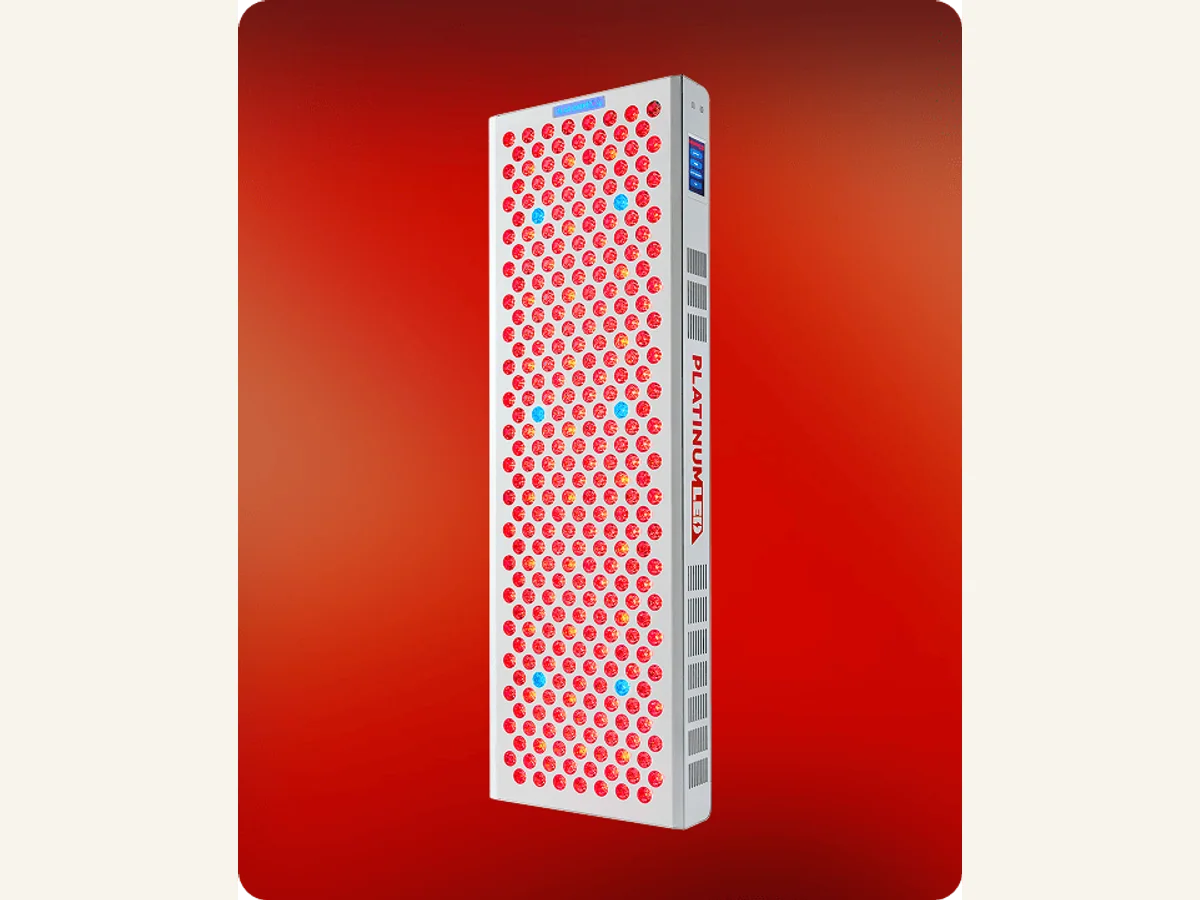
PlatinumLED BioMax
~$659-1,299The panel to buy if you want to dose by the numbers. PlatinumLED publishes third-party lab intensity reports per model and a joules-per-minute chart, so you can hit a target J/cm² instead of guessing.
Buying guide · How-to / dose / buy
Almost every dosing guide online is written by someone selling the panel. They give you minutes because minutes are easy. The dose is not minutes. It is joules, and the number that decides it, your panel’s real irradiance, is often about half what the box claims.
A correct red light dose is fluence in joules per square centimetre (irradiance in mW/cm² multiplied by seconds, divided by 1000): roughly 4 to 12 J/cm² for skin and 20 to 50 J/cm² at the skin for joints and muscle, calculated from your panel’s measured irradiance, not its advertised number.
Dose to the number on the box and you are probably getting about half the energy you think. Learn the true output, do the joules math, and stop before enthusiasm turns into over-dosing.
The panel to buy if you want to dose by the numbers. PlatinumLED publishes third-party lab intensity reports per model and a joules-per-minute chart, so you can hit a target J/cm² instead of guessing.
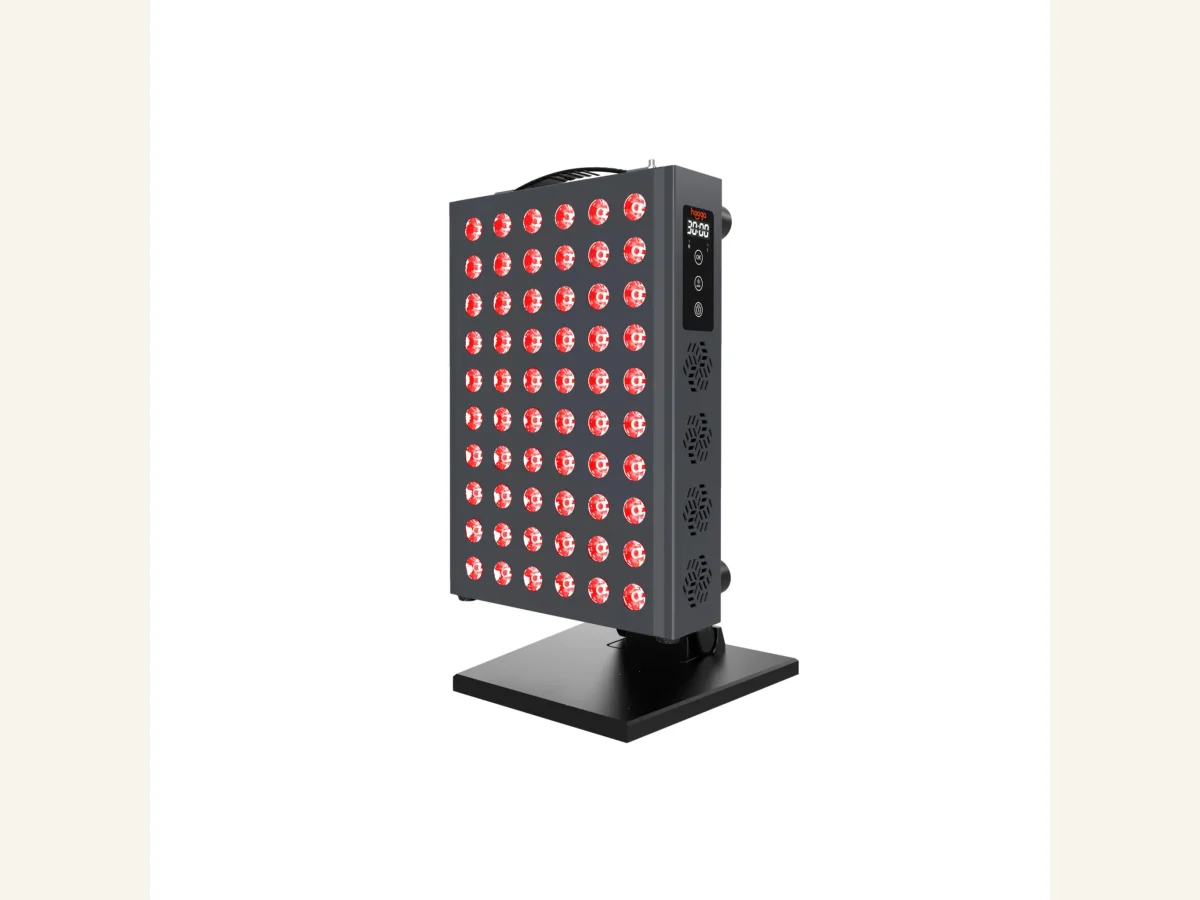
A clean dual-wavelength starter. Independent spectrometer tests put real output below the headline figure, so dose to the measured number, roughly 60 to 85 mW/cm² at six inches, not the box.
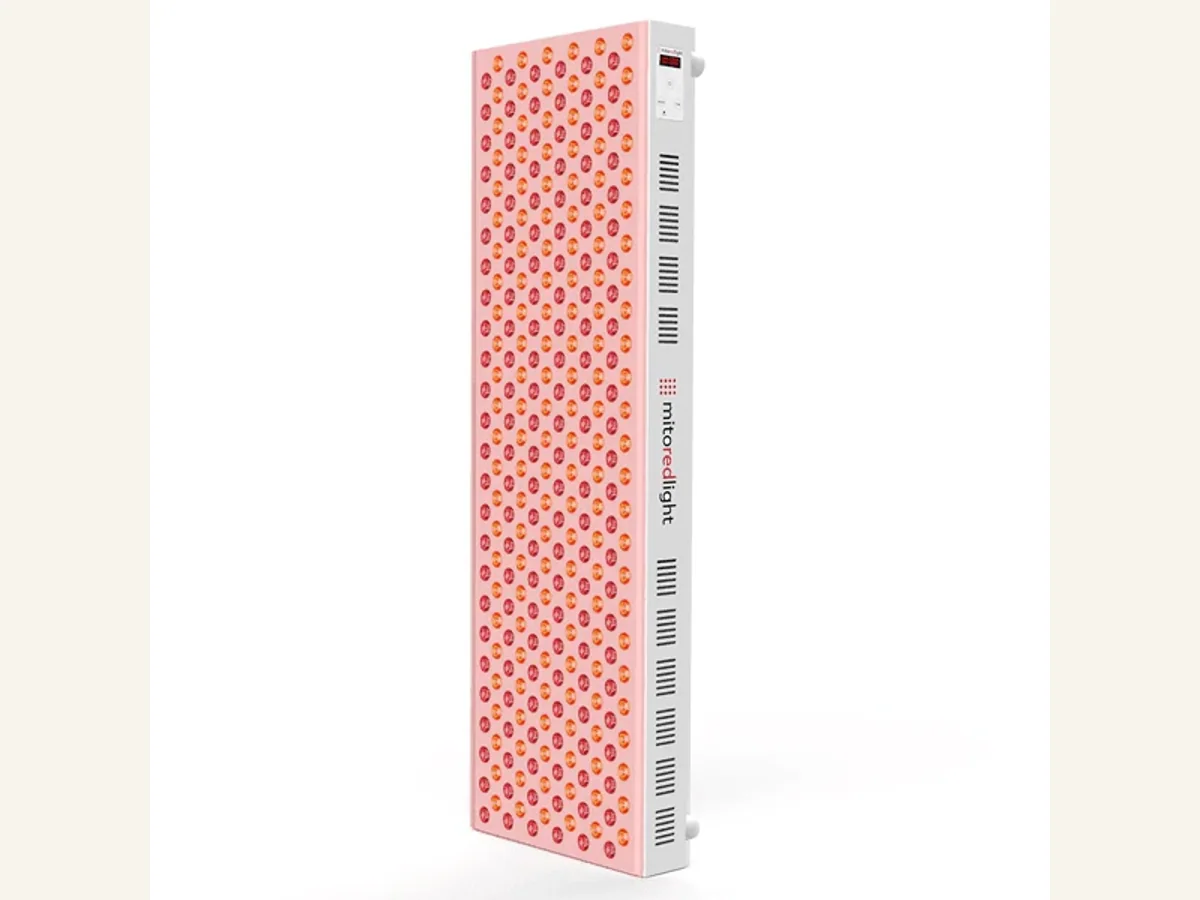
Publishes irradiance and the joules math on its own product pages, the transparency this category usually withholds. Useful if you want the dose calculation done for you.
The unit that matters is fluence, measured in joules per square centimetre (J/cm²). It is simply how much energy lands on a patch of skin, and you get it from one line of arithmetic: irradiance in milliwatts per square centimetre, multiplied by the number of seconds, divided by 1000. A panel reading 60 mW/cm² for five minutes (300 seconds) delivers 18 J/cm². That is the whole game.
This is why "use it for ten minutes" is a near-useless instruction on its own. Ten minutes from a weak panel at arm’s length and ten minutes from a strong panel pressed close are different doses by an order of magnitude. Time only means something once you know the irradiance it is multiplied against, and irradiance is exactly the number the industry is least honest about.
Most brands quote irradiance from a solar power meter, a cheap broadband sensor that reads high because it counts light a narrow-band spectrometer would discard. Independent testers who own spectrometers consistently find consumer panels running well below their advertised figures. GembaRed and the testers at Light Therapy Insiders put the gap at roughly half, and the broader pattern across independent measurements is the same: real output near half the advertised number.
A concrete case: one popular panel advertised 132 mW/cm² at six inches and measured around 60 mW/cm² average on a spectrometer. If you trusted the label and timed your session to it, you would land a little under half your intended dose. That is the load-bearing point of this whole guide. Dose to the advertised number and you under-treat, because the protocol printed on the box is calibrated to a number your panel does not actually produce.
Red light follows a biphasic dose response, the pattern Michael Hamblin’s reviews describe as the Arndt-Schulz curve: too little does nothing, the right amount helps, and too much reverses the benefit. In a controlled wound-healing model, 2 J/cm² produced the best result and 50 J/cm² did worse than no treatment at all. You cannot force a faster result by standing there longer.
This is the other reason the joules math matters. The goal is to land inside a window, not to maximise. Once you are hitting your target fluence three to five times a week, adding minutes is not a bonus; past the peak it is a cost. Most people who get poor results are either badly under-dosing through distance or over-dosing through enthusiasm.
Irradiance falls off fast as you back away. As a working rule, doubling the distance roughly quarters the intensity, so moving from six inches to twelve inches cuts your dose by about three quarters and you would need roughly four times the time to match it. Panels are large, extended light sources rather than points, so the real falloff is a little gentler close up, but the direction is the same.
The practical consequence: distance is a dose dial, not a comfort setting. If you like treating from twelve to eighteen inches to cover more of your body, accept that each patch is getting far less energy and lengthen the session accordingly. If you want short sessions, get close, around six inches for most goals, and time to the higher irradiance.
These are per-area session targets, calculated against a realistic measured irradiance of about 60 mW/cm² at six inches, the kind of figure a good consumer panel actually reads on a spectrometer rather than the inflated label. Adjust the minutes to your own panel’s true output.
Skin, collagen and wrinkles: aim for roughly 4 to 12 J/cm², which at a measured 60 mW/cm² is about one to three and a half minutes per area. The Wunsch and Matuschka trial that showed measurable collagen and wrinkle improvement used about 9 J/cm² (around two and a half minutes at that irradiance), twice a week.
Hair and scalp (early pattern thinning): roughly 1 to 10 J/cm², with the scalp parted so light reaches skin, which is well under three minutes a spot at 60 mW/cm². Hair is a separate buying decision covered in the hair-loss guide.
Joints and muscle recovery: because the target tissue is deeper, you dose higher at the surface, roughly 20 to 50 J/cm², which is about five to fourteen minutes per area at six inches. Pain and analgesia protocols sit in their own band above skin dosing, commonly around 10 to 30 J/cm².
Ask the brand for spectrometer-measured irradiance at a stated distance, with the protocol. A real answer names the tool, the distance and whether it is a centre reading or a panel average; a non-answer quotes one big number with no method. Brands that publish third-party lab reports, like PlatinumLED, or their own measured-at-distance tables are doing the thing the rest of the category avoids.
If you already own a panel and cannot get data, treat the advertised figure as roughly double the truth and dose to the halved number, or buy an inexpensive light meter knowing it will read high. Centre-of-panel readings also overstate what your whole body receives, so favour the average, not the hotspot.
Three to five sessions a week is the standard cadence, with at least six hours between sessions if you do more than one in a day. Consistency over weeks and months is what moves skin and hair outcomes; a heroic single session does nothing a sensible one cannot.
Expect skin changes over weeks and hair changes over months. The controlled trials ran roughly five to six months before reading results. If a sales page promises visible results in days, that is the marketing, not the dose.
Do not stare into the LEDs at close range, and use eye protection for sessions near the face. Clear it with a doctor first if you take photosensitising medication, including doxycycline, tetracycline, isotretinoin and other retinoids, amiodarone, or St John’s wort, and avoid self-treating over active cancer or undiagnosed lesions, or if you have lupus or another photosensitive condition or photosensitive epilepsy.
And skip the panel entirely if you will not track distance, time and measured irradiance. Without the joules math you are buying a guess; a fixed-distance LED mask or an in-clinic session will serve you better than an expensive panel used at the wrong dose.
Most skin goals land around 4 to 12 J/cm² and deeper joint or muscle work around 20 to 50 J/cm² at the skin. You reach the target by multiplying your panel’s measured irradiance by seconds and dividing by 1000.
Yes. The dose response is biphasic, so benefit rises, peaks, then reverses. In animal studies 2 J/cm² helped and 50 J/cm² did worse than nothing, so longer is not better.
However long it takes to hit your J/cm² target at your panel’s real irradiance, commonly one to fifteen minutes per area. The round "ten to twenty minutes" advice only holds if you know your true output.
Around six inches for most goals. Doubling the distance to twelve inches roughly quarters the intensity, so you would need about four times the time for the same dose.
Brands usually quote a broadband solar-meter reading at the centre hotspot. A calibrated spectrometer at true distance typically reads close to half, which is why the box protocol under-doses.
Red light around 630 to 660nm is absorbed in the first few millimetres and suits skin and hair; near-infrared around 810 to 850nm penetrates deeper for joints and muscle. Many panels combine both.
By David Persson · Updated 2026-06-24 · Corrections: hi@agewell.guide
The Agewell Briefing
A sourced weekly read on longevity products, clinics and research, with a clear answer on what is worth trying.
One email a week. Unsubscribe with one click.