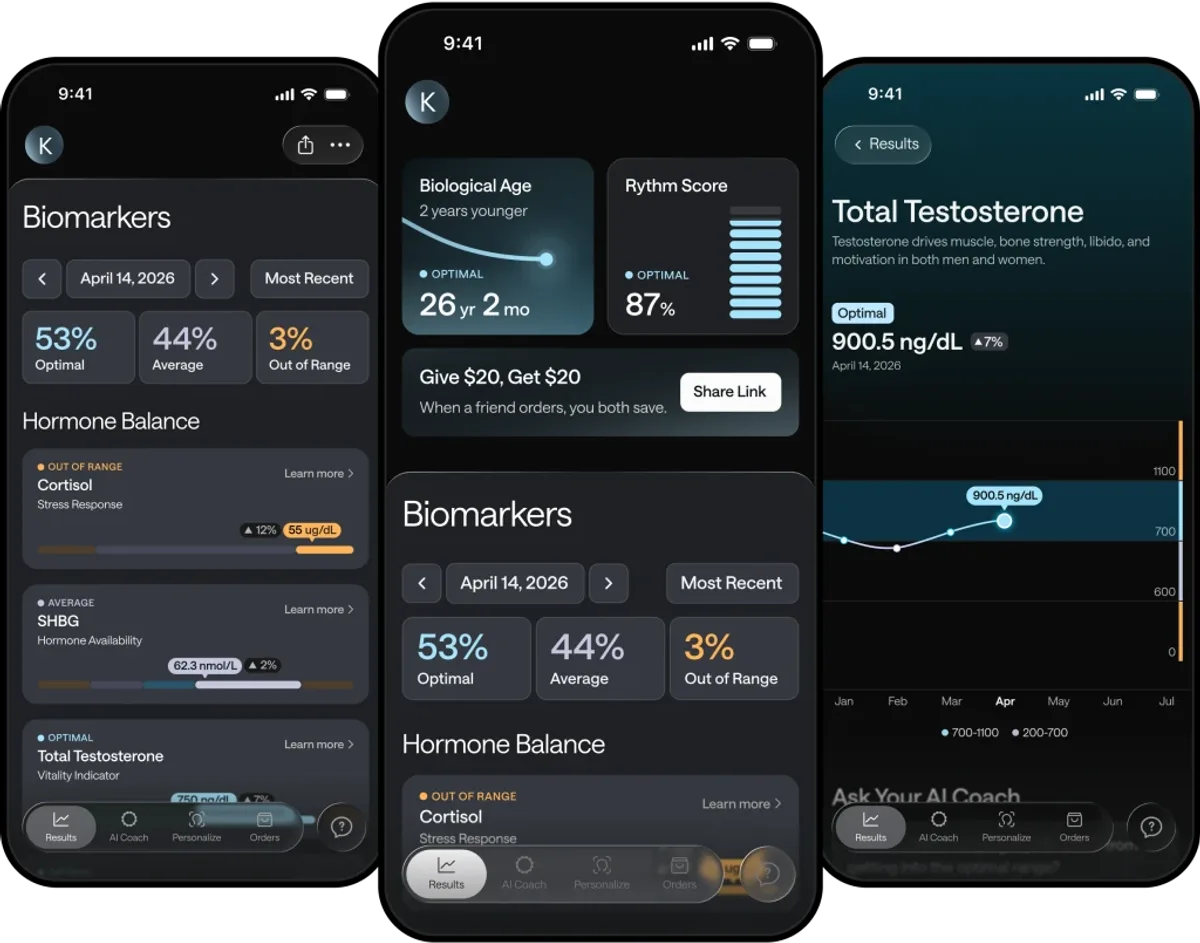
Monthly home panel (default plan)
Rythm, monthly
$79/test · $948/yr + shipping & taxThe easiest repeat draw available. Twelve readings a year of a 25+ marker panel is more data than most healthy buyers can interpret.
Buying guide · Review / worth it / how often
Rythm sells the easiest blood draw in the market: a Tasso+ device on the upper arm, a FedEx pickup and results in about two days, every month, for $79 a test. The convenience is real. The question is what a monthly reading of this particular panel can tell you that a quarterly one cannot, and what the panel leaves out.
Rythm is worth it for a narrow buyer: someone actively testing a specific change who will repeat a small panel every 8 to 12 weeks and has a clinician to act on an abnormal result. At the default monthly cadence it costs $948 a year before shipping and tax, about 2.6 times Function Health and nearly 5 times Superpower, and for the panel’s headline markers, from ApoB to hsCRP, a one-month change has to exceed 17% to 96% before it is more than normal variation.
The draw is excellent; the cadence is a sales decision. Get a broad baseline first, then use Rythm every 90 days for the question you are actually testing.
The easiest repeat draw available. Twelve readings a year of a 25+ marker panel is more data than most healthy buyers can interpret.
Same kit, skipped to the maximum 90 days the plan allows. Matches how often most of these markers are worth rechecking after a change.

160+ tests a year across two draws at a lab. Better first purchase if you have no recent baseline.
100+ biomarkers from one included lab draw. Home draws and follow-up tests cost extra.
Rythm is a subscription home blood test. Each kit uses the Tasso+, a single-use device that sits on the upper arm and pulls capillary blood into a tube by vacuum. You return it by FedEx within seven days of receiving the kit, a CLIA-certified, CAP-accredited lab runs the panel, and results land in the Rythm app; Rythm says within 48 business hours when the sample is returned inside that window. Rythm states that a state-licensed physician reviews and signs off every result before you see it. Price: $79 per test, 30% off the first, plus shipping and tax, billed monthly; you can skip up to 90 days at a time or cancel without a fee (Rythm FAQ, checked 2026-10-26).
The panel lists 25+ markers: total and free testosterone, estradiol, SHBG, cortisol, TSH, ApoB, LDL, HDL, total and remnant cholesterol, hsCRP, triglycerides, vitamin D, ferritin, fructosamine, albumin, uric acid, creatinine, eGFR, ALP and GGT, plus progesterone, free T3 and free T4 for women and haemoglobin and haematocrit for men. The app adds an AI coach, a proprietary Rythm Score and a Biological Age estimate.
For a person who avoids lab visits, that is a genuinely good product. Independent reviewers we read, including one critical of the price, describe the arm draw as the easiest collection they have tried.
The gaps are specific, and several of them are the markers a baseline needs most. There is no HbA1c: Rythm measures fructosamine instead, which reflects roughly the last two to three weeks of blood sugar and suits a monthly cadence, but HbA1c is the standard test for long-term blood sugar and one of the tests diabetes is diagnosed with. There is no fasting glucose or insulin. There is no Lp(a), the one-time cholesterol test current lipid guidance says every adult should have once. Liver coverage is ALP and GGT without ALT or AST. The blood count is haemoglobin and haematocrit, for men only. There is no PSA.
None of that is a flaw if you already have those numbers from a doctor or a broad annual panel. It is a flaw if Rythm is your only bloodwork, because the panel will repeat the markers it has every month while never measuring the ones it skips.
Every lab value moves on its own from week to week, even in a healthy person whose habits have not changed. Laboratory medicine measures that movement as within-person biological variation, and the European Federation of Clinical Chemistry and Laboratory Medicine (EFLM) publishes it for most of Rythm’s panel. A standard rule turns it into a threshold: for two results to differ with 95% confidence, the change has to exceed about 2.77 times that variation. The table below applies the rule to Rythm’s markers using biological variation alone. Lab imprecision and any capillary-versus-venous difference add to it, so the real threshold is higher than the number shown.
Read it with a real example. An ApoB of 100 mg/dL would have to come back below about 83 or above about 117 before one month can be told apart from the next. An hsCRP of 1.0 mg/L can read 1.9 the following month with nothing changed. A total testosterone of 600 ng/dL can read 350 or 850 on noise alone, before time of day, fasting and sleep are considered. Fructosamine is the exception: it moves little on its own, so a real change shows up quickly.
Guidelines say the same thing from the other direction. After a cholesterol-lowering change, the ACC/AHA guideline rechecks lipids four to 12 weeks later and then every three to 12 months, not monthly. Twelve readings a year mostly measures noise and gives the app something to chart. Four readings a year, timed to a change you have made, measures the change.
| Marker | Within-person variation (EFLM) | Smallest meaningful change, biology alone | Monthly retesting is |
|---|---|---|---|
| Fructosamine | 2.3% | about 6% | Informative: moves little on its own |
| Creatinine | 4.4% | about 12% | Rarely needed in healthy adults |
| HDL cholesterol | 5.7% | about 16% | Slow to respond; quarterly is enough |
| ApoB | 6.1% | about 17% | Useful 4-12 weeks after a change, not monthly |
| Vitamin D (25-OH D3) | 6.8% | about 19% | Low noise; quarterly shows a dose change |
| LDL cholesterol | 7.8% | about 22% | Same as ApoB |
| Ferritin | 12.9% | about 36% | Only while a clinician is treating low iron |
| Total testosterone | 15% | about 42% | Mostly noise unless timed and fasting |
| TSH | 17.9% | about 50% | Mostly noise in a healthy thyroid |
| Triglycerides | 19.8% | about 55% | Mostly noise; last meal matters |
| hsCRP | 34.7% | about 96% | Mostly noise; a cold can double it |
| Free testosterone | 55% | about 150% | Noise at monthly resolution |
The device is cleared; the panel is not reviewed. The FDA cleared the Tasso+ on August 12, 2022 (510(k) K221131) as a single-use blood lancet, which covers the collection device. It does not cover Rythm’s lab assays, its Rythm Score or its Biological Age estimate, none of which the FDA has evaluated.
Rythm says it validated each assay in-house against same-day venous samples. We found no peer-reviewed study or assay-by-assay report for the full Rythm panel, and neither did the most detailed independent review we read. Published studies of Tasso-collected blood show good agreement with venous draws for some liver markers and for testosterone, but they are small and some were funded by Tasso. One user comparison on a GLP-1 forum found Rythm close to Quest on everything except testosterone, which is the marker with the most built-in variation anyway.
The practical risks are in the handling. Rythm requires the tube to be at least 75% full, rejects samples for haemolysis or too little plasma, and says markers can be missing if a sample falls outside its stability window. That is normal for capillary collection and a reason to treat one odd result as a reason to retest, not to act.
Monthly Rythm is the most expensive way to buy routine blood markers in this comparison and the cheapest per draw. Whether that is a good trade depends entirely on whether you need the draws.
| Option | Price | Draws per year | Markers | Collection | After an abnormal result |
|---|---|---|---|---|---|
| Rythm, monthly | $79 per test, $948/yr + shipping & tax | 12 | 25+ (fixed panel) | Tasso+ upper-arm device at home | Physician sign-off; Rythm says follow-up is yours with your own doctor |
| Rythm, every 90 days | about $316/yr + shipping & tax | 4 | 25+ (fixed panel) | Tasso+ upper-arm device at home | Same |
| Function Health | $365/yr | 2 | 160+ tests a year | Venous draw at a lab; home draw offered | See our Function Health review |
| Superpower | $199/yr | 1 included; extra tests cost more | 100+ | Venous draw at a partner lab; home draw extra | In-app care team (per Superpower) |
Rythm’s site says “97% of members improve their health.” The page gives no definition of improvement, no time frame and no method. Without those, the number cannot be checked or compared.
The Biological Age and Rythm Score formulas are not published. Our purchases-to-skip guide covers why biological-age numbers from a blood draw deserve caution: re-running the same sample can move the result. Treat the app’s age as a motivational graphic, not a measurement.
The 90-day money-back guarantee applies to first-time purchases only, and you have to complete the full test and ask for the refund within seven days of receiving your results. That makes it a guarantee on the first kit, not on the subscription.
Rythm fits a person who already has a recent broad baseline, has made one specific change, and wants to see whether it worked without a lab visit: a diet change aimed at ApoB or triglycerides, a vitamin D dose, iron repletion that a clinician is managing. Set the plan to 90 days, test at the same time of day and fasting state each time, and decide in advance what result would make you change course.
Skip it, or skip it for now, if you have no baseline, because the panel cannot tell you your HbA1c or Lp(a). Skip it if you would react to every red flag in the app, because at monthly resolution many of those flags are noise. And skip the monthly cadence if your doctor already orders the same markers once or twice a year; the twelfth reading of a stable vitamin D does not buy anything the fourth one did not.
For most healthy buyers, not monthly. At the default cadence it costs $948 a year before shipping and tax, more than Function Health ($365) or Superpower ($199), for a narrower panel. It earns its price when you skip to the 90-day maximum and use it to check one specific change.
The Tasso+ collection device is FDA-cleared, and Rythm says its lab is CLIA-certified and CAP-accredited and that each assay was validated against venous blood. No peer-reviewed accuracy study of the full Rythm panel has been published. Small independent studies of Tasso-collected blood show good agreement for some markers.
Usually once a year, or a few weeks to three months after a specific change you want to check. For most markers on Rythm’s panel, normal week-to-week variation is large enough that a monthly result cannot reliably show a real change.
No. Rythm measures fructosamine, which reflects about the last two to three weeks of blood sugar. HbA1c, the test used to diagnose and monitor diabetes, is not on the panel, and neither are fasting glucose, insulin or Lp(a).
Function first if you have no recent baseline: 160+ tests a year for $365. Rythm second, on a 90-day cadence, if you then want to recheck a handful of markers at home after a change.
By David Persson · Updated 2026-10-26 · Corrections: hi@agewell.guide
The Agewell Briefing
A sourced weekly read on longevity products, clinics and research, with a clear answer on what is worth trying.
One email a week. Unsubscribe with one click.