How much does a hyperbaric chamber cost? Home chambers, rentals and clinic sessions, priced
The prices online run from $80 a session to $79,000 for a chamber because “hyperbaric chamber” covers three different machines delivering two different doses. A $100 session and a $300 session are often not the same treatment. This guide prices each option and says which dose you actually get for the money.
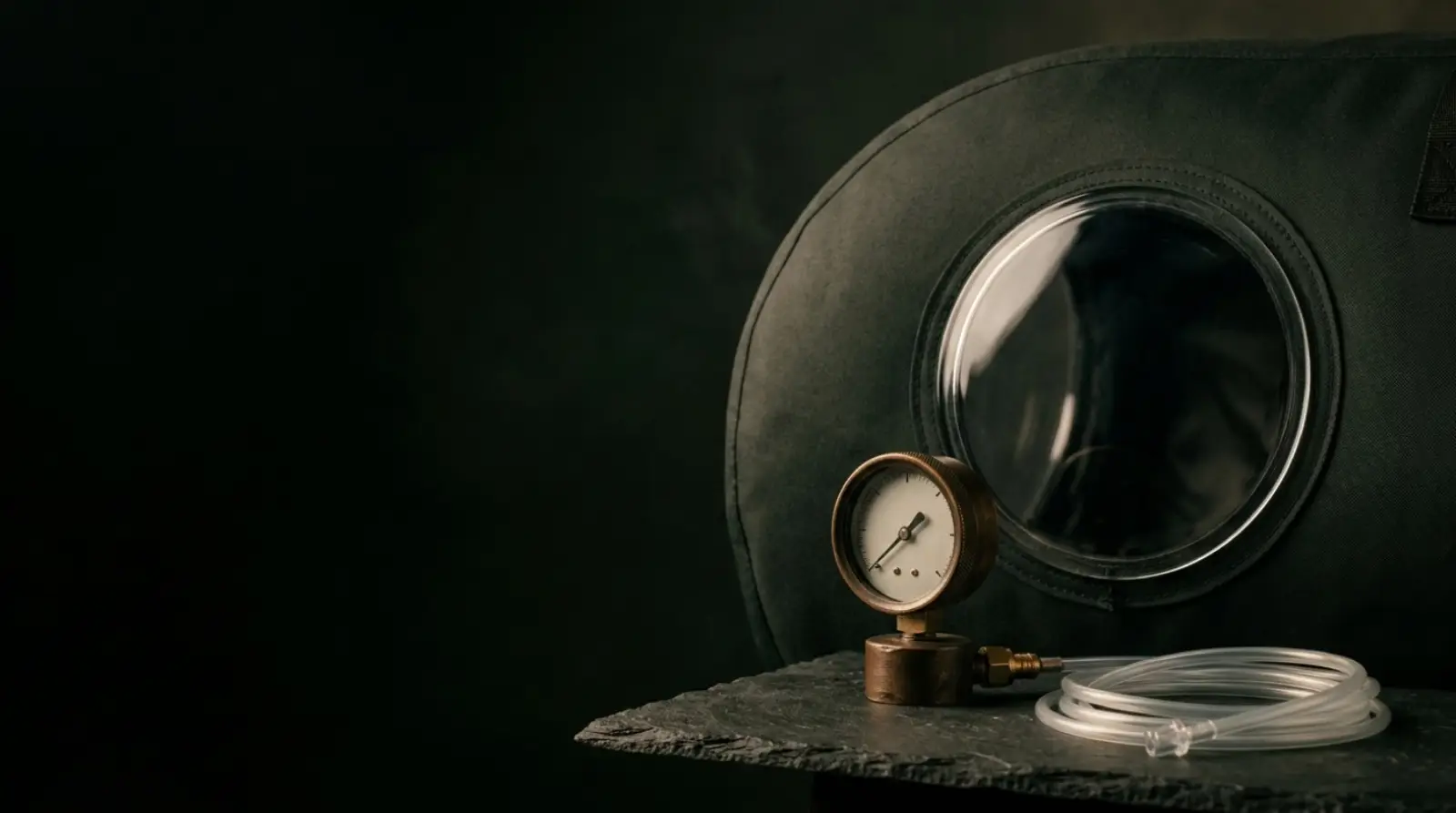
Editorial image, not a specific manufacturer’s chamber or an Agewell test.
QUALIFY$80-1,029 a session · $4,095-79,000 to buy11 min
Answer-first
As of October 22, 2026, a soft-sided home chamber costs $4,095 to $21,995 and a hard-shell home chamber $26,999 to $79,000; hard shells also need a $1,450 to $1,799 oxygen concentrator if none is included, while soft chambers are cleared to run on air. Monthly rentals run $749 to $1,799. At a clinic, a mild 1.3 ATA session costs $80 to $125, a 2.0 ATA session at an independent center $110 to $340, and a hospital visit $316 to $1,029 on MDsave. The 60-session, 2.0 ATA course from the 2020 Hachmo aging study costs $5,200 to $9,000 at the two cheapest 2.0 ATA centers we priced, roughly a fifth to a third of the cheapest 2.0 ATA home hard shell ($27,999).
Agewell verdict
Book the studied dose, don’t buy it: a 2.0 ATA clinic course that states 100% oxygen costs a fraction of a home hard shell, and a soft chamber cannot deliver that dose at any price. The evidence behind the aging claim is one small uncontrolled study, so treat even the clinic course as an experiment, not a fix.
The only package in our sample that matches the 2020 aging study on every stated point: 60 sessions of 90 minutes at 2.0 ATA, $150 a session, with 100% oxygen stated. Its 90-minute packages at 2.0–2.4 ATA run $5,000 for 20 and $8,000 for 40. The catch is geography and time: 60 weekday visits over about 12 weeks.
The lowest prices we found for a 2.0 ATA hard-shell chamber: $110 for 60 minutes and $150 for 90 as single sessions, or $3,200 for 40 × 90 minutes plus $2,000 for 20 more, which builds the 60-session course for $5,200. Its page describes HBOT as breathing pure oxygen but does not say what its own chamber delivers, so ask before you book.
Medical HBOT under physician supervision, priced as a prepaid cash visit at participating hospitals; MDsave’s listing does not state pressure or oxygen. This is the route Medicare and insurers pay for when you have one of the listed conditions, and the most expensive per session in our sample.
A 27-inch soft-sided chamber rated at 1.3 ATA (4 psi), the lowest purchase price we found. Newtowne requires a prescription, and soft chambers are FDA-cleared for acute mountain sickness, not for aging. It cannot reach the 2.0 ATA the aging research used.
The cheapest chamber we confirmed at 2.0 ATA, the study pressure; home hard shells in our sample run $26,999 to $79,000. They supply oxygen from a concentrator (OxyRevo states 90–97%, Airvida’s Alpha 93%) rather than the 100% of the study protocol, and our FDA 510(k) database search on October 22, 2026 found no clearance listed under Airvida or OxyRevo.
Soft-sided chambers rent from $749 a month and hard shells from $1,799 at Healing the Hyperbaric Way, with two- to four-month minimums and up to 80–90% of rent credited toward a purchase at the providers we checked. Useful for testing whether you will keep the habit before paying five figures. Run a rented soft chamber on air, as cleared.
How we priced this
We recorded the published cash price from each provider’s or seller’s own page on October 22, 2026: single sessions and packages at clinics, monthly rental rates, and list or sale prices for home chambers. For every clinic we also recorded the pressure (ATA) and oxygen source the provider states, because those two numbers decide which treatment you are buying. Where a provider does not state them, the table says so.
Coverage rules come from Medicare’s national coverage determination for hyperbaric oxygen (NCD 20.29) and two large insurers’ published policies. The dose definitions come from the Undersea and Hyperbaric Medical Society (UHMS), and the study protocol from the 2020 paper in Aging. We did not take sessions or test chambers for this guide. Prices change often, so treat each one as a dated snapshot and confirm it before you pay.
Hyperbaric chamber prices compared
Every option below gets called a hyperbaric chamber. The second column is the one that matters: it tells you whether you are paying for the pressure and oxygen the research used.
Hyperbaric chamber and session prices, checked October 22, 2026
Option
Pressure and oxygen
Price
Examples
Mild clinic session
1.3 ATA soft chamber; oxygen usually not stated
$80–125 a session
K Wellness $100 (20 for $1,200); Pioneer Valley 60 for $4,900
Needed for hard shells; off-label in soft chambers
$1,450–1,799
DeVilbiss 10L $1,450 to $1,750 across three sellers; Airvida $1,799
Prices from each provider’s own page on October 22, 2026. OxyHealth sells its chambers by quote only and publishes financing from $198 a month. Summit to Sea adds $275–650 shipping.
Pressure and oxygen are the dose
Hyperbaric oxygen therapy means breathing close to 100% oxygen inside a chamber pressurized above sea level. UHMS, the medical society for the field, defines it as near-100% oxygen at 1.4 ATA or more, and the conditions it supports are usually treated at 1.9 to 3.0 ATA. The aging study most often cited to sell home chambers used 2.0 ATA with 100% oxygen by mask.
Soft-sided chambers are a different machine. They are FDA-cleared at 1.3 ATA for acute mountain sickness, by prescription, and are designed to be pressurized with air. UHMS says the FDA prohibits using them with supplemental oxygen, and that a soft chamber on air delivers no more oxygen to the body than an oxygen mask at sea level. A $100 mild session can be relaxing; it is not the treatment in the study.
Price alone will not tell you which machine you are in. ATX charges $200 for a 60-minute session at 1.3–1.75 ATA, more than Healthy Self ATL charges at 2.0 ATA. Many clinics do not state the oxygen concentration on their price page, and OxyRenew, a 2.0 ATA hard-shell center, describes concentrated oxygen through a mask or cannula rather than 100%. Ask two questions before you book: what pressure, and what percentage of oxygen.
What the 60-session aging protocol costs, five ways
The 2020 study behind the “hyperbaric reverses aging” headlines (Hachmo et al., Aging) ran 60 sessions over three months, five a week, each 90 minutes at 2.0 ATA on 100% oxygen with a five-minute air break every 20 minutes. Thirty-five adults aged 64 and over enrolled, 25 had usable telomere samples, and there was no control group. Here is what that exact course costs by route, checked October 22, 2026.
The studied course (60 × 90 minutes at 2.0 ATA, 100% oxygen), priced by route
Route
Matches the studied dose?
Cost for the course
The catch
Healthy Self ATL, two packages (Atlanta)
Pressure yes (2.0 ATA hard shell); oxygen not stated
$5,200 (40 × 90 min $3,200 plus 20 × 90 min $2,000)
Ask what oxygen concentration you breathe
ATX Hyperbarics package (Austin)
Yes: 2.0 ATA, 100% oxygen stated
$9,000
One city; about 90 hours in the chamber over 12 weeks
Hospital outpatient, 60 visits at the MDsave average
Likely, physician-supervised; MDsave states no pressure or oxygen
About $31,440 (our arithmetic: 60 × $524)
Hospital programs are built around listed conditions and may require a consultation
Mild 1.3 ATA center (Pioneer Valley, 60 sessions)
No: lower pressure, oxygen not stated
$4,900
Cheaper because it is a different, weaker exposure
Home soft chamber
No: 1.3 ATA on air
$4,095–21,995 plus a prescription
Cannot reach 2.0 ATA at any price
Home hard chamber
Partly: 2.0 ATA on concentrator oxygen, unsupervised
$27,999–79,000 at 2.0 ATA, plus $1,450–1,799 for a concentrator if not included
No FDA clearance for home use found; fire risk and maintenance are yours
Protocol from Hachmo et al., Aging (2020). Prices from provider pages on October 22, 2026. The Healthy Self and hospital figures are our arithmetic from published package and visit prices.
The math on owning versus renting the dose
The cheapest 2.0 ATA home hard shell we confirmed, the $27,999 Airvida Ultra, costs about three ATX courses or five Healthy Self courses before you add a concentrator, delivery or repairs. Spread over one 60-session course it works out to about $467 a session; over three courses, about $156. Airvida also sells professional delivery, setup and training for its Elite chamber at $3,999. Ownership only starts to pencil out if a clinician wants you to repeat the full course several times, and even then the home unit runs on concentrator oxygen without the supervision the study had.
A soft chamber looks cheaper, but the comparison is not like for like. The $4,095 Newtowne A4-27 costs less than either clinic course and will never deliver 2.0 ATA. If the reason you are shopping is the aging research, the soft chamber is not a cheaper version of it.
Time is the real argument for owning. Sixty 90-minute weekday sessions is roughly 90 hours in a chamber plus travel. If you live far from a 2.0 ATA center, a hard-shell rental at $1,799 a month, with a four-month minimum (about $7,200), lets you test the routine before you buy; the $749 soft rentals cannot reach 2.0 ATA.
Clinic sessions: what each price usually buys
At the low end, $80 to $125 usually buys a 1.3 ATA soft-chamber session. K Wellness in Long Beach lists 60 minutes at 1.3 ATA for $100, or 20 sessions for $1,200, and Pioneer Valley Hyperbaric in Massachusetts falls to about $82 a session at 60 sessions.
Independent 2.0 ATA centers charge $110 to $340 a single session, and packages bring that down to $70 to $250 a session (ATX’s 20 × 90 minutes is $5,000). Longer sessions cost more: OxyRenew lists $240 for 60 minutes and $340 for 120.
Hospital programs price differently because they bill insurance for listed conditions. On MDsave, a prepaid hospital HBOT visit runs $316 to $1,029, with an average of $524, and listings like St. Joseph Medical Center in Kansas City require a consultation first.
Renting a home chamber
Rental is the middle path. Healing the Hyperbaric Way rents soft chambers from $749 a month and hard shells from $1,799, with a two-month minimum on soft and four on hard, a 10 LPM concentrator included, and 80% of rent credited toward a purchase. Newtowne rents its soft chambers for $900 to $1,595 a month without a concentrator, with shipping extra and rent-to-own from the second month. Carbon Wellness MD charges $1,250 to $1,500 with a three-month minimum, requires a prescription and credits 90% toward a purchase. Pioneer Valley Hyperbaric rents by the week: $800 for the first, then $600.
Two cautions. Some rentals include a concentrator, but UHMS says the FDA prohibits supplemental oxygen in soft chambers, so run a rented soft chamber on air. And a rental still puts setup, supervision and fire safety in your home.
Buying a soft-sided chamber
Soft chambers cost $4,095 to $21,995 in our sample. Newtowne sells the 27-inch A4-27 for $4,095 on sale, the 34-inch A4-34 for $5,795 (regularly $7,495) and the 40-inch A4-40 for $8,995. Summit to Sea lists the Shallow Dive at $7,995, the Dive at $9,995, the Grand Dive at $13,995 and the 60-inch Grand Dive Pro Plus at $21,495 to $21,995, plus $275 to $650 shipping. Its Shallow Dive is rated at 1.2 ATA rather than 1.3. OxyRevo sells soft chambers rated at 1.4 and 1.5 ATA, including the 1.5 ATA Apex32 at $7,999, above any soft-chamber clearance we found. OxyHealth publishes no chamber prices; it sells by quote and advertises financing from $198 a month.
Newtowne, Summit to Sea and OxyHealth require a prescription, and the soft-chamber clearances we found in the FDA database are for acute mountain sickness at 1.3 ATA or below. Larger diameters cost more mainly for comfort and for room for a second person, not for a higher dose.
Buying a hard-shell chamber
Hard shells start at $26,999 for the OxyRevo Quest30, sold in 1.5 and 2.0 ATA versions, and $27,999 for the 2.0 ATA Airvida Ultra; they rise to $39,999 for the seated Airvida Elite and $48,499 to $48,999 for the OxyRevo Space60 Pro, and top out at $79,000 for the lie-down Airvida Alpha in our sample. They supply oxygen from a concentrator: OxyRevo states 90 to 97% and Airvida’s Alpha 93%, not the 100% of the study protocol.
Our search of the FDA 510(k) database on October 22, 2026 found no clearance listed under Airvida or OxyRevo, and the only clearances we found that list the home as a use setting are soft chambers for altitude sickness. UHMS does not endorse in-home hyperbaric therapy at any time. Fire is the serious risk: a review of chamber fires from 1923 to 1996 found that every fatal fire happened in an oxygen-enriched atmosphere above 28% oxygen, and the FDA’s August 2025 letter to health care providers reports fires with HBOT devices that caused serious injuries and deaths. A hard shell at home makes you the safety officer.
The costs after the sticker price
Oxygen is the first add-on. A 10 LPM concentrator costs $1,450 to $1,799 across the four sellers we checked, and some rentals and hard-shell packages include one. Repairs are the second. OxyHealth’s current repair page says to call for the zipper and standard repair fee; an archived May 2026 version of the same page listed $2,500 for a zipper repair or replacement, $2,000 for a standard repair and $900 for a loaner. Warranties run from one year (Airvida) and two years (Newtowne, Summit to Sea) to five years (OxyHealth).
Resale is better than the folklore suggests. Dealer asking prices for used and demo chambers we found sat 7 to 33% below the new price, for example a used Summit to Sea Grand Dive at $12,995 against $13,995 new. Those are asking prices from dealers, not completed private sales.
When insurance or Medicare pays
Medicare covers hyperbaric oxygen only in a chamber and only for 15 listed conditions, including carbon monoxide poisoning, decompression illness, gas gangrene, radiation tissue damage, chronic refractory bone infection and diabetic foot wounds of Wagner grade III or higher after 30 days of failed standard care. Its list of conditions it does not cover names senility explicitly. A course taken to age well is paid out of pocket.
Private insurers follow the same pattern. UnitedHealthcare’s policy, effective May 1, 2026, covers a defined list and calls mild hyperbaric oxygen therapy unproven and not medically necessary for any indication. Aetna’s policy lists senility among experimental uses.
HSA and FSA funds follow the IRS medical-care test. The IRS says a generalized desire to monitor or improve health is not sufficient, so a chamber bought for wellness does not qualify; a treatment for a diagnosed condition may.
Rent, book or buy: the decision
Start from why you want it, because the reason picks the route and the route sets the price.
Which option fits which goal
Your goal
Best route
What it costs
A listed medical condition (wound, radiation injury, CO poisoning)
Hospital program through your doctor
Covered if you meet the criteria; cash $316–1,029 a visit
The studied aging protocol
A 2.0 ATA clinic that states 100% oxygen
About $9,000 for 60 × 90 minutes at the cheapest package we found
Relaxation or curiosity
A few mild 1.3 ATA sessions
$80–125 a session
Testing a home habit
A two- to four-month rental
$749–1,799 a month
Repeated courses under a clinician’s plan
A hard shell, with the fire-safety plan in writing
$26,999–79,000 plus oxygen and setup
Prices from the tables above, checked October 22, 2026.
Who should skip
Skip buying any chamber if your reason is the aging headline: the study dose is available as a clinic course for a fraction of a hard shell, and a soft chamber cannot deliver it. Skip the soft-chamber-plus-concentrator bundle, which adds the oxygen its clearance rules out, and the fire risk that comes with it. And skip anything sold on the promise of reversed aging; one uncontrolled study in 25 analyzed adults, whose authors disclosed shareholding in and employment at AVIV Scientific, is a reason for curiosity, not a five-figure purchase.
This guide is informational, not medical advice. Hyperbaric oxygen has real risks: UHMS puts middle-ear barotrauma, the most common side effect, at about 2% and oxygen seizures at about 1 in 10,000 treatments at 2.0 to 3.0 ATA, and some people should not use it at all. Talk to a physician before any course.
FAQ
How much does a hyperbaric chamber cost?
A soft-sided home chamber costs $4,095 to $21,995 and a hard-shell home chamber $26,999 to $79,000, plus a $1,450 to $1,799 oxygen concentrator for a hard shell if none is included. Monthly rentals run $749 to $1,799. Prices checked October 22, 2026.
How much is one hyperbaric oxygen therapy session?
As of October 22, 2026, a mild 1.3 ATA session costs $80 to $125, a 2.0 ATA session at an independent center $110 to $340, and a hospital visit $316 to $1,029 on MDsave, with an average of $524.
Can I buy my own hyperbaric chamber?
Yes, with a prescription for a soft-sided chamber, which is FDA-cleared at 1.3 ATA for acute mountain sickness. Hard shells that reach 2.0 ATA are sold for home use from $27,999, but we found no FDA clearance listed for home use under the brands we priced.
Is a home chamber cheaper than clinic sessions?
Not for the studied dose. The 60-session, 2.0 ATA course costs $5,200 to $9,000 at the two cheapest 2.0 ATA centers we priced, a fifth to a third of the cheapest 2.0 ATA home hard shell ($27,999). A soft chamber is cheaper but cannot reach 2.0 ATA.
Does insurance cover hyperbaric oxygen therapy?
Only for listed medical conditions. Medicare covers 15, such as carbon monoxide poisoning and qualifying diabetic foot wounds, and names senility as not covered. UnitedHealthcare calls mild hyperbaric therapy unproven for any indication.
Can I add an oxygen concentrator to a soft chamber?
Sellers bundle them, but soft chambers are designed to run on air, and UHMS says the FDA prohibits using them with supplemental oxygen. Every fatal chamber fire in a 1923–1996 review happened in an atmosphere above 28% oxygen.
Can I pay with an HSA or FSA?
Only when it treats a diagnosed medical condition. The IRS says a generalized desire to monitor or improve health is not sufficient, so a chamber bought for wellness does not qualify.
How many hyperbaric sessions did the aging study use?
The 2020 telomere study (Hachmo et al., Aging) used sixty sessions over three months, five a week, each 90 minutes at 2.0 ATA on 100% oxygen with five-minute air breaks every 20 minutes.
How much does a 40-session HBOT course cost?
At independent 2.0 ATA centers, 40 sessions cost $2,800 (Healthy Self ATL, 60 minutes) to $8,000 (ATX Hyperbarics, 90 minutes at 2.0–2.4 ATA), checked October 22, 2026. Mild-tier packages run $2,000 (Synergy) to $3,400 (Pioneer Valley, 1.3 ATA) for 40.