What’s a good grip strength by age? (and what to buy to measure it)
Every fitness blog runs the same age-by-sex chart, and more than one sources it from a dynamometer’s own instruction manual. The useful question is not whether your number looks respectable next to a stranger’s chart. It is whether it sits below a real clinical cutoff, and whether the $30 gadget on your desk agrees with the $387 one in a hand clinic.
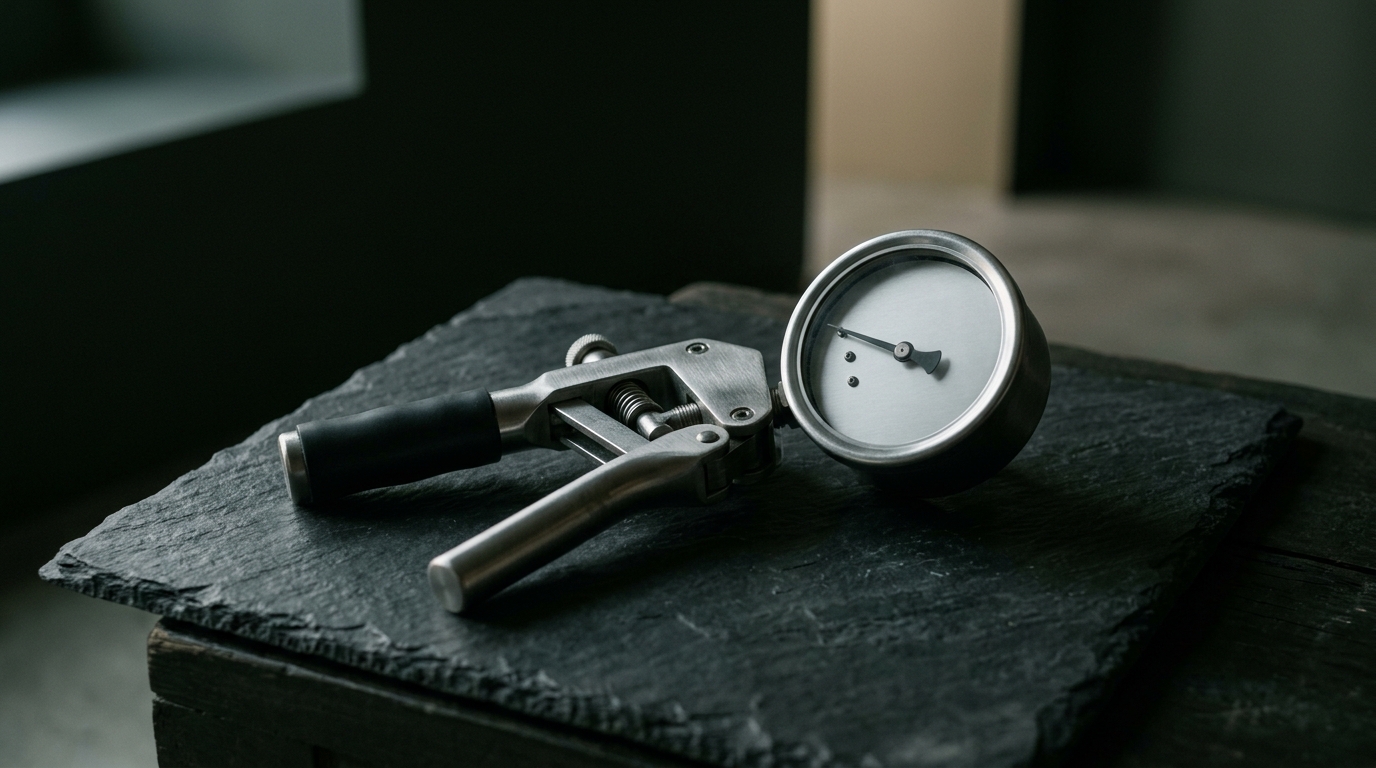
Editorial image, not a product photo. See the product cards below for the actual devices.
BUY ONE$30-3909 min
Answer-first
A good grip strength sits at or above the median for your age and sex: roughly 50 kg (110 lb) for men in their forties, falling to about 32 kg (71 lb) by their eighties, and about 31 kg (68 lb) for women in their forties, falling to about 19 kg (42 lb) by their eighties, per the largest published normative dataset (49,964 people). Each 5 kg below your number is linked to about 16% higher all-cause mortality in a 139,691-person study, and a $30-70 validated digital dynamometer tracks that number nearly as well as the $387 clinical gold standard.
Agewell verdict
Buy one validated digital dynamometer in the $30-70 range to get a real baseline and track the monthly trend; it agrees with the $387 clinical hydraulic gold standard within about 2 kg. Skip the expensive clinical model unless you are a clinician or researcher, and do not confuse a spring-loaded hand gripper with a dynamometer: one measures the number that predicts risk, the other only trains the squeeze, and there is no trial evidence that training it changes the risk.
A 51-person hospital validation found this digital dynamometer correlates 0.94 with the Jamar hydraulic gold standard (ICC 0.97), with the Jamar reading only about 1.9 kg higher on average. Good enough to track your own trend for a fraction of the clinical price.
A hydraulic analog gauge from the same family clinics use, at a step down from Jamar pricing. Worth it if you want a hydraulic mechanism rather than a digital strain gauge, but it does not out-measure the Camry for a home trend.
The instrument nearly every normative study, including the one this page cites, is built around. Buy it only if you are a clinician, researcher, or need the exact reference instrument; a healthy home user gets the same trend from the $30 Camry.
Trains the squeeze; does not measure it, and has no trial evidence that training grip alone moves the mortality numbers below. Agewell’s existing gadget scoring covers this device on its own merits (forearm training, cheap, fun) without borrowing the dynamometer’s mortality data to sell it.
What counts as a good grip strength
A good grip strength is, simply, at or above the median for your age and sex. The largest normative dataset in the field pooled 60,803 measurements from 49,964 people across twelve British population studies: men’s median grip peaks at 51 kg (112 lb) between 29 and 39, then eases to about 50 kg (110 lb) in the forties, 48 kg (106 lb) in the fifties, 45 kg (99 lb) in the sixties, 39 kg (86 lb) in the seventies and 32 kg (71 lb) by the eighties. Women peak at 31 kg (68 lb) between 26 and 42, then ease to about 31 kg (68 lb) in the forties, 29 kg (64 lb) in the fifties, 27 kg (60 lb) in the sixties, 24 kg (53 lb) in the seventies and 19 kg (42 lb) by the eighties.
One honest caveat: that dataset is British, and Agewell is a US-first site. A separate, much smaller US study built on the NIH Toolbox project (1,232 adults, ages 18-85) reports a mean dominant-hand grip of 49.7 kg (110 lb) for men 25-29, and 18.7 kg (41 lb) for the nondominant hand of women 75-79. Those anchor points land within a couple of kilograms of the British peaks and troughs above, which is the useful takeaway: use the chart to find your rough band, not to litigate a single kilogram, and expect any two credible studies to disagree slightly.
Why the number is a mortality statistic, not a strength brag
The reason to care is not bragging rights. The PURE study followed 139,691 people across 17 countries and found each 5 kg lower grip strength was linked to about 16% higher all-cause mortality, 17% higher cardiovascular mortality, and measurable increases in heart attack and stroke risk. Grip strength predicted death better than systolic blood pressure in the same cohort.
That does not mean a weak grip causes death. Grip is a proxy for total-body muscle mass, nervous-system function and general physiological reserve, the things sarcopenia and frailty research actually track. It is a cheap, fast gauge for a much bigger picture, which is exactly why it is worth measuring and exactly why squeezing a gripper is not the same project as fixing the underlying number (more on that below).
The clinical cutoff is not the same as “below average”
Falling below your age band’s median is not a medical problem; ages, sexes and testing protocols vary enough that "below average" describes roughly half of everyone. The number that actually matters clinically is the EWGSOP2 sarcopenia-screening cutoff, published by the European Working Group on Sarcopenia in Older People: below 27 kg (60 lb) for men or 16 kg (35 lb) for women. That threshold sits well below the age-band median even for people in their eighties, and it is meant to flag probable sarcopenia alongside other criteria (muscle mass, physical performance), not to diagnose it from grip alone.
Decline itself is not linear. Grip strength holds roughly flat through midlife, then the same normative dataset found the prevalence of "weak grip" (more than 2.5 standard deviations below peak) climbing to about 23% of men and 27% of women by age 80. The takeaway for a Baseline Month reading: a falling trend in your fifties and sixties is the useful early warning, not a single number compared to a chart.
How to measure it: cheap digital versus clinical hydraulic
The standard protocol: seated, shoulder relaxed, elbow bent to a right angle, wrist neutral, and take the mean of three squeezes per hand rather than your single best effort. Test the same hand, same position and same time of day each time so the trend is comparable.
A 51-patient hospital validation study compared the Camry digital dynamometer against the Jamar hydraulic gold standard and found a strong correlation (r = 0.94) and excellent agreement (ICC 0.97), with the Jamar reading about 1.9 kg higher on average, a gap the authors attributed to differences in tactile feedback between a hydraulic squeeze and a digital strain gauge, not a flaw in either device. For tracking your own trend at home, that gap does not matter; for a clinical reference figure, it is why hand clinics still buy the Jamar.
Which device to buy
For almost everyone, a $30-70 digital dynamometer like the Camry EH101 is the right buy: it is validated against the clinical instrument, cheap enough to not think about, and gives you the same monthly trend line a $387 device would. A mid-tier hydraulic analog gauge, like the Baseline 200 lb model, is a reasonable step up if you prefer a hydraulic mechanism, but it will not out-measure the cheaper digital option for a home user.
The Jamar hydraulic dynamometer is the instrument the reference studies are built on, and it is the right buy only if you are a clinician, a researcher, or need the exact instrument the norms were calibrated against. A healthy person tracking their own number does not need the $387 version to get a usable answer.
Training grip is a different question than measuring it
A spring-loaded hand gripper is sold on the same mortality statistic this page just cited, and that is the leap to watch for. Grip strength predicts risk because it reflects whole-body muscle mass and strength reserve; training the gripper trains the squeeze, which is not proven to move the whole-body reserve the mortality studies actually measured. There is no trial showing that grip-training alone lowers mortality risk, only that a low grip number correlates with higher risk.
The actual lever, if your number is trending down, is the same one behind most of Agewell’s strength coverage: full-body resistance training, adequate protein, and treating a falling trend as a prompt to lift, not to squeeze a $20 gadget. A gripper is a legitimate, cheap forearm exercise on its own terms; it is just not the fix for the number on this page.
Who should skip
Skip chasing decimal precision from any handheld meter, cheap or clinical; test-retest variation of a kilogram or two is normal, so trust the trend across months, not one reading. Skip self-diagnosing sarcopenia from a single low number: the EWGSOP2 criteria combine grip strength with muscle mass and physical-performance measures, and a clinician should make that call.
Skip testing through pain: arthritis, a recent wrist or hand injury, or carpal tunnel symptoms can distort a reading and testing through them is not worth it. And this is not a medical workup: a sudden, unexplained drop in strength on one or both sides needs a clinician promptly, not a home gadget.
FAQ
What is a good grip strength for my age?
At or above the median for your age and sex: roughly 50 kg (110 lb) for men in their forties down to about 32 kg (71 lb) in their eighties, and about 31 kg (68 lb) for women in their forties down to about 19 kg (42 lb) in their eighties.
Does grip strength really predict how long I’ll live?
In a 139,691-person study across 17 countries, each 5 kg lower grip strength was linked to about 16% higher all-cause mortality and 17% higher cardiovascular mortality, a stronger predictor than systolic blood pressure in the same cohort.
What grip strength counts as clinically weak?
The EWGSOP2 sarcopenia-screening cutoff is below 27 kg (60 lb) for men and below 16 kg (35 lb) for women, well under the age-band average even in your eighties. It is a screening flag used alongside other criteria, not a standalone diagnosis.
Is a cheap digital dynamometer accurate enough?
A 51-patient validation study found a $30-70 Camry digital dynamometer correlates 0.94 with the $387 Jamar clinical hydraulic gold standard, with the Jamar reading only about 1.9 kg higher on average. That is close enough to track your own monthly trend.
Should I buy a hand gripper instead of a dynamometer?
No, they do different jobs. A dynamometer measures the number linked to mortality risk; a spring gripper trains the squeeze. There is no trial evidence that gripper training alone lowers mortality risk, only that a low grip number correlates with higher risk.
How should I test my grip strength at home?
Seated, elbow bent to a right angle, wrist neutral, three squeezes per hand averaged rather than your single best effort. Test the same hand, position and time of day each time so the trend stays comparable.
Does grip strength decline with age, and can I do anything about it?
Yes, it holds roughly flat through midlife then declines, with the share of people below a clinical weak-grip threshold reaching about a quarter by age 80. Full-body resistance training and adequate protein are the actual levers, not squeezing a gripper.