Budget starter
Bodylastics stackable bands
~$50-120Best first buy if you want cable-machine style handles, a door anchor and a low-cost way to test whether band training sticks. The inner safety cord is the practical detail to pay for.
Buying guide · Best / small space / compare
The best small home gym is not a folding bench buried under gadgets. For most people it is a band set that progresses cleanly, one trustworthy anchor point, enough floor space to hinge and press, and a rule that every new accessory must solve a movement problem.
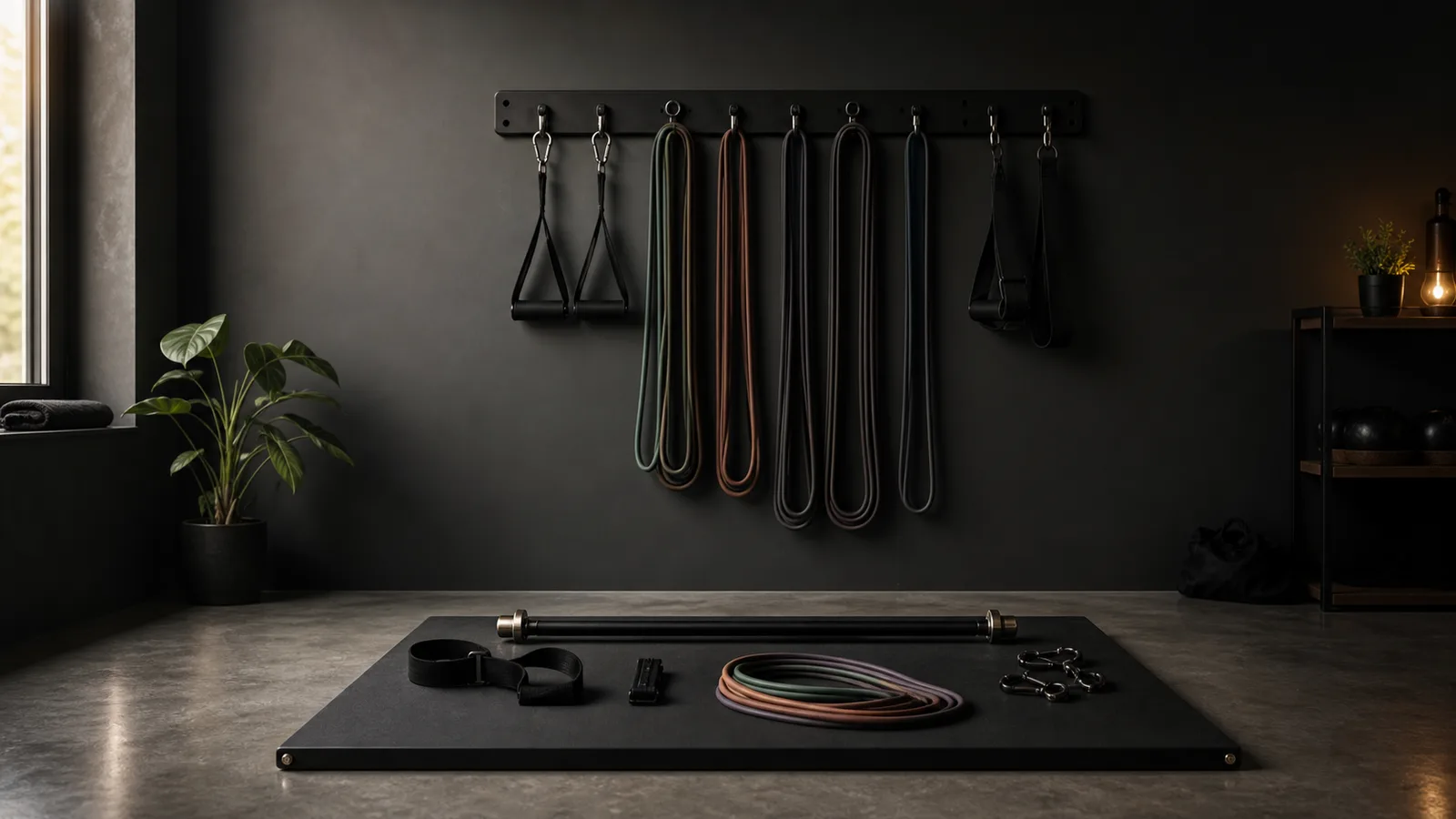
For most small homes, start with quality loop bands, handles, a real wall anchor mounted into structure, and a mat; buy a floor plate or premium bar system only after bands have become your main strength tool.
Build the $150-300 version first. Harambe is the premium enthusiast rig, X3 is the compact travel-friendly plate/bar system, Clench is the modular anchor-and-footplate route, and cheap tube kits are useful until heavy lower-body training exposes their limits.
Best first buy if you want cable-machine style handles, a door anchor and a low-cost way to test whether band training sticks. The inner safety cord is the practical detail to pay for.
The clean budget-to-serious path for pull-up assistance, squats, hinges and presses. The official care notes are the tell: protect them from concrete, knurling and abrasive plates.
The most sensible upgrade path if you want wall anchors, handles, loop bands and a footplate without committing to one closed system on day one.
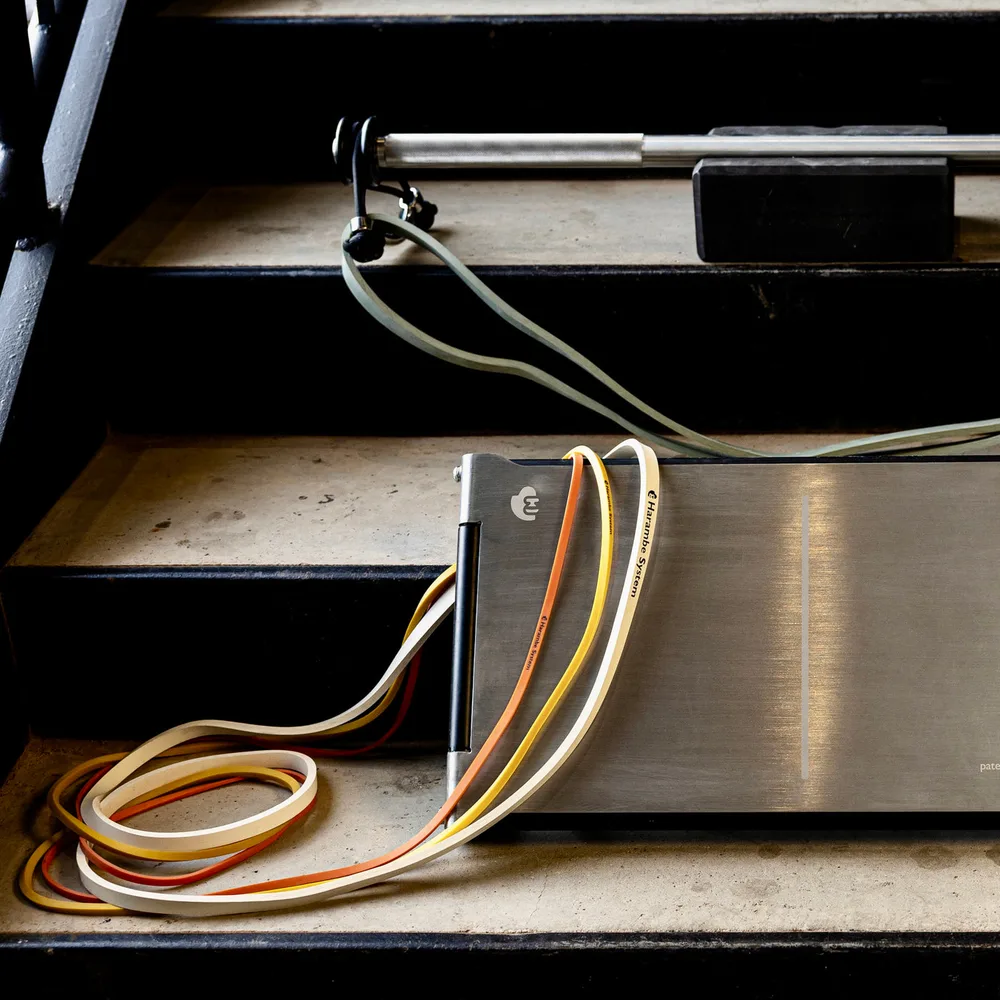
The premium band-gym answer for people who already know they prefer bands. Smooth load paths and the ecosystem are the point; the price is not casual.
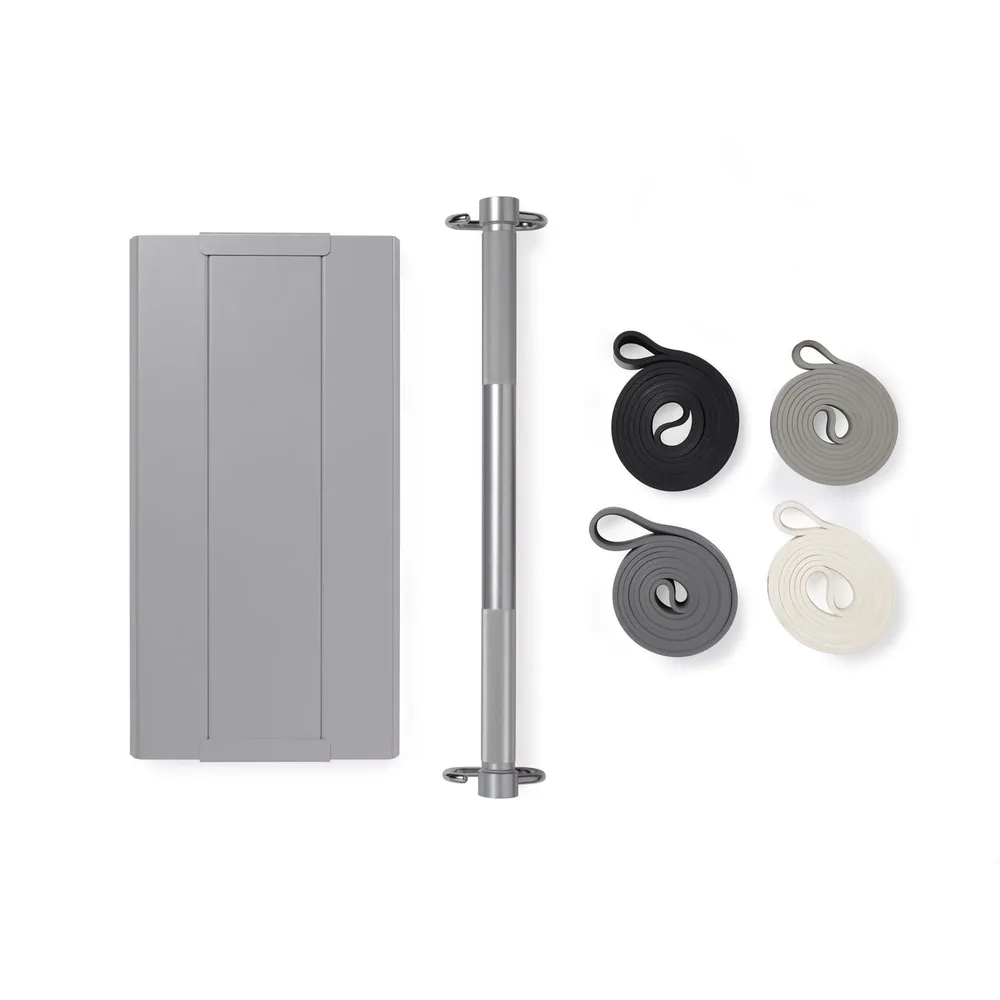
Compact and easy to store, with a plate/bar format that appeals to lifters who want fewer parts. It is less flexible than a wall-anchor setup for horizontal pushes and rows.
Do not start by asking which band claims the highest pounds. Start with the six movements a small gym must cover: squat or split squat, hinge, horizontal push, horizontal pull, vertical push, and vertical pull or pulldown. The equipment that makes those movements repeatable wins.
This guide is document-verified synthesis, not a lab test. Agewell did not measure band force curves or run wear testing. We cross-checked published product specs, independent equipment testing, clinical evidence on elastic resistance, and user reports from resistance-band forums to decide what is worth buying first.
The short version: a small home gym should be boring. Quality loop bands, handles, one mounted anchor, one mat, and optionally a footplate beat a pile of novelty handles that turn every workout into setup admin.
Elastic resistance is not just rehab theater. A 2019 systematic review and meta-analysis found similar strength gains from elastic resistance and conventional resistance training across upper- and lower-body outcomes. That does not mean a band deadlift is identical to a barbell deadlift; it means bands are legitimate if the program has enough tension, volume and progression.
ACSM's 2026 resistance-training update is useful for small-home buyers because its main message is adherence over complexity. Bands, bodyweight and home routines can produce meaningful strength, hypertrophy and physical-function benefits when they are used consistently.
The equipment implication is simple: buy the setup you will use twice a week, not the one with the most aggressive sales page. For many apartment owners, that means a quiet band system before adjustable dumbbells, a rack or a cable tower.
The budget build is a set of 41-inch loop bands, a pair of handles or grips, a mat, and a door anchor while you learn the exercises. Bodylastics is the easiest cable-feel starter because the handled tubes stack and its original sets use an inner safety cord. Serious Steel or Clench loop bands are the better base if you care about assisted pull-ups, lower-body work and heavier standing exercises.
Avoid the false economy of no-name mega bundles if the bands have vague resistance ratings, thin carabiners and no material disclosure. A snapped band is not just annoying; it can hit your face or damage a room. Buy fewer, better bands and add resistance in useful gaps.
Mini bands and fabric glute bands are not a small home gym. They are warm-up, rehab and accessory tools. They do not replace long loop bands or stackable tubes for full-body strength work.
Premium band systems are not magic because the bands are special. They are better when the plate, rollers, bar length, handles and attachment geometry make heavy resistance smoother and safer. That matters most for squats, hinges, overhead presses and loaded carries where stepping on a wide band becomes awkward.
Harambe is the enthusiast premium pick because the system is built around a serious plate/bar ecosystem and the current CyberBundle is priced like a real gym purchase. It is rational only if band training is the main strength plan, not a side tool.
X3 is easier to store and the official page listed the X3 System at $399 during a July sale, down from $549, when this guide was checked. The tradeoff is geometry: a plate-only system is neat for vertical loaded movements, but wall anchors make chest presses, rows, flyes and pulldowns less annoying.
Clench sits in the middle. You can buy loop bands, wall anchors, handles, a footplate and bars as separate decisions. That is less glamorous than one flagship box, but it is how most small gyms should grow.
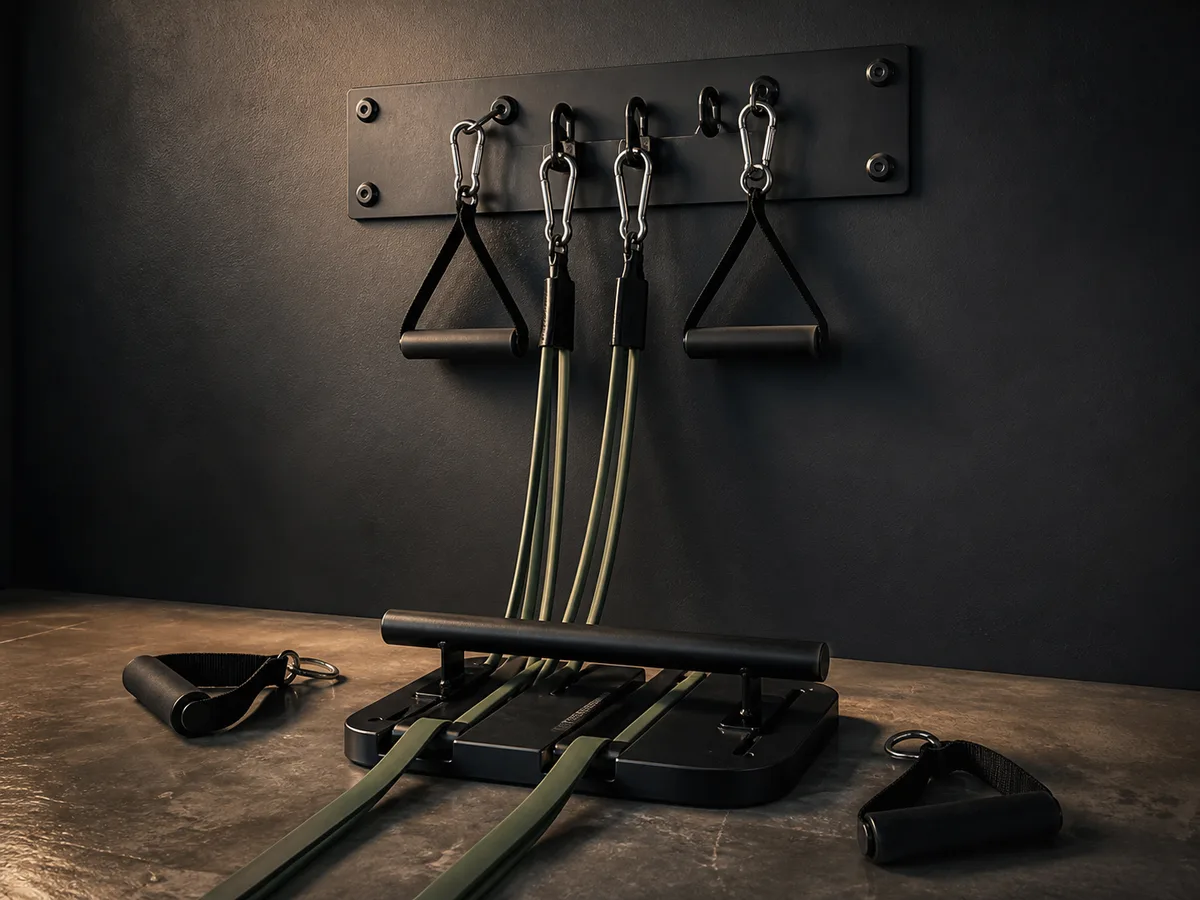
A door anchor is the cheapest way to learn whether bands fit your training. It is also the first thing you outgrow if you train often. It constrains angles, depends on door quality, and should only be pulled from the side that forces the door closed.
A real wall anchor changes the category. Rows, chest presses, face pulls, anti-rotation work, pulldown patterns and low-to-high presses become repeatable. Clench sells single wall anchors and multi-anchor setups; TRX's XMount is not a band-specific product, but its documentation is a useful safety model because it specifies load-bearing walls, ceiling studs or beams.
Do not mount dynamic resistance into drywall alone. Use studs, masonry with proper anchors, or hire someone who installs fitness hardware. The risk is not a fallen picture frame; it is a stretched band plus metal hardware returning toward the user.
A floor plate is worth it when you repeatedly do heavy hinges, squats, overhead presses or calf raises with loop bands. It gives a stable channel for the band, protects the latex from shoes and rough floors, and lets you use a bar without guessing where the band should sit under your feet.
The wear issue is real. Serious Steel explicitly warns users to avoid direct contact with knurling, asphalt, concrete, resistance-board systems or abrasive surfaces. That does not ban plates; it means plate edges and channels matter. Smooth rollers or broad rounded contact points are worth more than another claimed 100 pounds of resistance.
Skip the footplate for the first month if you mostly do rehab, mobility, curls, lateral raises and assisted pull-ups. Buy the plate when the missing movement is obvious: heavy lower body work that feels unstable without one.
The forum pattern is consistent enough to matter. r/ResistanceBand users repeatedly praise Harambe's feel and ecosystem, but the same conversations flag price as the limiting factor. X3 has loyal users, especially for compact storage and travel, but it is polarizing around exercise geometry and setup constraints.
The strongest user insight is that anchor points change band training. One detailed r/ResistanceBand write-up called anchor points a game changer because chest presses and rows are easier from a wall or post than from a base plate alone. That matches the practical movement screen above.
The second insight is band length. Shorter bands can create useful pre-stretch for shorter users and some plate systems, but 41-inch loops remain the safest default because they work for pull-up assistance, anchoring and general strength. Buy specialized 32-, 34- or 38-inch bands after you know which movements need them.
If you have roughly six by eight feet, build the gym vertically. Put the anchor line on one load-bearing wall, keep bands on hooks above waist height, and leave the floor clear except for a mat and optional footplate. A fold-flat bench is useful only if it does not become permanent clutter.
For an apartment, prioritize silent equipment: bands, mat, adjustable bench, doorway pull-up bar if the frame is safe, and a storage rail. Skip battle ropes, slam balls, shaky towers and anything that needs a permanent footprint before you have proved the habit.
For a garage or spare room, the best upgrade after bands is not more bands. It is a stable pull-up bar or small cable trainer if you have the space. Bands are excellent; they are not the only resistance curve worth owning.
Use a 30-day test before buying premium hardware. Run the same six movements twice per week: split squat, Romanian deadlift, chest press, row, overhead press and pulldown or face pull. Score each session on setup time, ability to progress, joint comfort, anchor confidence, and whether the band rubs on anything sharp.
If the blocker is exercise angles, buy a wall anchor. If the blocker is heavy lower-body stability, buy a footplate. If the blocker is resistance gaps, buy better bands. If the blocker is motivation, a $1,229 premium system will not fix it.
Replace bands when they show cracks, white stress marks, tackiness, cuts or obvious loss of elasticity. Store them out of sun and heat. Latex is consumable equipment, not a lifetime machine.
For most apartments, the best small home gym is a quality loop-band set, handles, a mat, a door anchor to start, and a properly mounted wall anchor if you can install one. It is quiet, compact and covers the main strength patterns.
Yes, if the exercises are loaded hard enough and progressed over time. The limitation is not that bands cannot work; it is that high-strength users may need multiple bands, better anchors and a plate or bar to make heavy movements practical.
Buy neither first unless you already like band training. X3 is the more compact plate/bar system; Harambe is the premium enthusiast ecosystem. Most buyers should prove the habit with bands and anchors before spending at that level.
Not on day one, but a wall anchor is the highest-value upgrade for a band gym because it improves rows, presses, pulldowns, face pulls and anti-rotation work. Install it only into structure, not drywall alone.
A floor plate is worth it if you train heavy squats, hinges or overhead presses with loop bands. It is not necessary for light rehab, warm-ups or travel workouts.
Start with a reputable 41-inch loop-band set or Bodylastics-style stackable tubes, handles, a mat and a door anchor. Expect to spend roughly $50-150 before adding a wall anchor or footplate.
By David Persson · Updated 2026-07-05 · Corrections: hi@agewell.guide
The Agewell Briefing
A sourced weekly read on longevity products, clinics and research, with a clear answer on what is worth trying.
One email a week. Unsubscribe with one click.