Best blood test memberships 2027: Function Health vs Superpower vs InsideTracker and more
A year of bloodwork now costs less than one premium checkup, and every company selling it counts biomarkers its own way. We checked each price, draw count and state exclusion on the providers’ own pages on November 10, 2026, then lined them up on two things a buyer can compare: what one blood draw actually costs, and whether the panel measures the markers most worth paying for.
Agewell editorial image of baseline measuring tools; not a product photo, not any provider’s kit and not an Agewell test setup.
QUALIFY$99-1,305/yr13 min
Answer-first
For most healthy US adults, Function Health is the best broad blood test membership we checked in November 2026: $365 a year for two lab draws, about $182.50 each, with ApoB, Lp(a), HbA1c, insulin, hs-CRP and TSH on the menu. Superpower is the cheapest broad panel at $199 a year for one draw (plus one follow-up test for new members), and a one-time Quest or Labcorp panel at $399 to $405 beats both if you do not want a subscription. None of them is your doctor, so decide who acts on an abnormal result before the first draw.
Agewell verdict
Qualify. Choose by price per draw and by whether the panel measures ApoB, Lp(a), HbA1c, insulin, hs-CRP and TSH, not by the headline biomarker count. Lp(a) only needs measuring once, so a membership that repeats it every year is not buying you anything extra.
160+ tests a year across an annual and a mid-year draw at Quest, with all six core markers included. ApoB, Lp(a) and TSH run once a year only, which is enough for most healthy buyers. Not offered in Rhode Island or Hawaii; testing in New York and New Jersey costs more, by an amount Function does not publish. A home or office draw is available, but Function shows its charge only when you book.
$199/yr · 1 draw, plus 1 follow-up test for new members
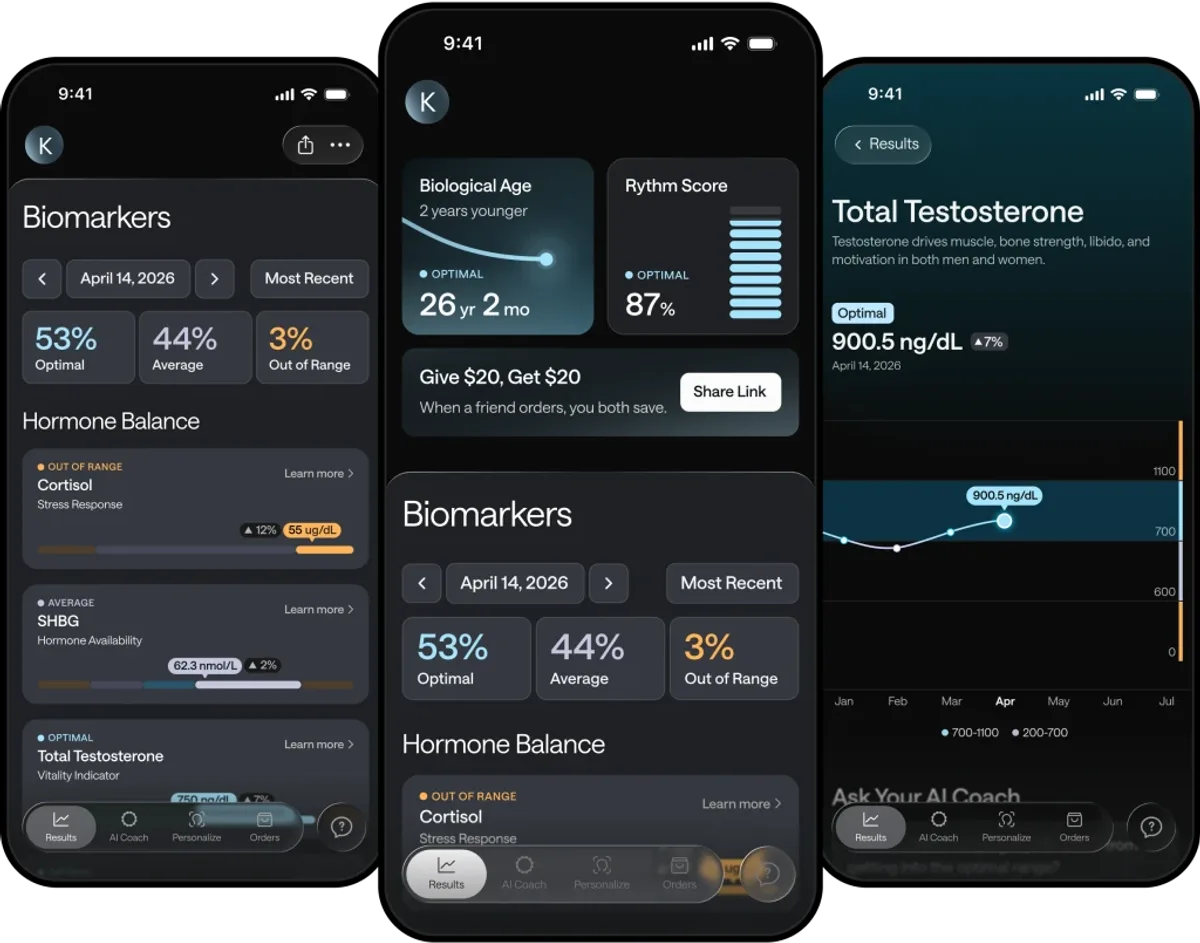
100+ biomarkers from one Quest draw, live in 41 states plus DC. The $199 baseline includes ApoB, HbA1c, hs-CRP and TSH, but not Lp(a), which Superpower sells as a $79 add-on, and its own panel list has no fasting insulin. A home draw costs $119 more. The app also offers supplements, prescriptions and peptides; those are medical decisions for your own doctor and are not part of this verdict.
85+ indicators from one draw, including ApoB, HbA1c, insulin, hs-CRP and TSH, with a free results discussion with an independent provider. Lp(a) is $51 extra ($45 plus Quest’s $6 fee), and Quest sells it only once per customer per lifetime, which is all most adults need. The cleanest buy if you want one baseline and no renewal date.
A 101-marker baseline that includes all six core markers and a urinalysis, then three smaller follow-up panels of 20 to 40 markers about every 90 days, chosen from your baseline results; OneTwenty does not list in advance which markers a follow-up repeats. Draws are at 2,000+ lab locations, and no home draw is priced. The cheapest quarterly cadence here, from the youngest company: sign-up runs through a beta site, the apps are listed as coming soon, and refunds end seven days after purchase. Medication add-ons come through telehealth partners; consult your own doctor, and treat that part as outside this comparison.
A test marketplace rather than a bundle. The Core panel lists 138 biomarkers at Quest, all six core markers among them, at $197.59 for members or $276.75 without membership (non-members get no clinician review). A per-visit draw fee is passed through at cost: $15 at Quest, $11.50 at Labcorp and $9.50 at BioReference, or a flat $99 for an at-home draw where available.
50 biomarkers including ApoB, Lp(a), HbA1c, insulin and hs-CRP, drawn at Quest and reviewed by SteadyMD clinicians. Requires an Oura Ring Gen3 or Ring 4 with an active membership, and is not available in Arizona, Hawaii, New Jersey, New York or Rhode Island.
75+ biomarkers per Comprehensive test at Quest, shown beside your sleep and strain data if you wear a WHOOP. WHOOP announced on August 18, 2026 that Advanced Labs no longer requires a WHOOP membership, with testing that starts at approximately $150, ordered by a licensed provider and drawn at Quest in the US. Without the strap it is a plain clinician-reviewed panel, so compare it on price per draw like the rest. Our July review found unused credits expire 12 months after purchase. WHOOP’s site, shop and support pages blocked both a browser and a crawler on November 10, 2026, so the tier prices and the 75+ count come from WHOOP’s own pages as shown in search results that day, and we could not check its marker list.
The easiest draw on this page, an arm device at home, but a 25+ marker panel without HbA1c, insulin or Lp(a). Best as a 90-day recheck of one specific change after you already have a broad baseline.
The most expensive broad option per draw, $380.50 on the two-test plan. Its own test page itemizes 48 biomarkers for the InsideTracker Ultimate tier, including ApoB, insulin, HbA1c and hs-CRP but not Lp(a) or TSH; its store says up to 54 and lists none. Pay for the recommendations engine, not for the panel.
How we picked and compared
A product made this page if it sells US consumers a blood panel they can order without their own doctor, as a membership, a bundle or a repeatable panel, and publishes its price on its own website. We read each provider’s pricing page, FAQ, terms or product page on November 10, 2026. Where a page would not load, we say so next to the number. Nothing here is a lab result of ours: we did not buy these panels for this guide, and no score below comes from a test we ran.
We compared five things: the cost of one included blood draw, whether the panel includes six markers buyers most often pay for, how the blood is collected, who reviews an abnormal result, and the fine print on states, renewals and refunds. The order of the shortlist follows the buyer job each product fits best, not a commission. There are no affiliate links on this page. Some of these companies have contacted Agewell about coverage; none has a commercial relationship with us, and that contact played no part in what made the list or where it sits.
The comparison, priced November 10, 2026
The headline price is a yearly number, but what you buy is blood draws. Divide one by the other and the order changes: Superpower is cheapest per year; Rythm is cheapest per draw, with a much narrower panel; OneTwenty undercuts Superpower per draw from the second year on; and InsideTracker is the most expensive broad option on either measure.
Blood test memberships and panels compared on price, draws and collection (checked November 10, 2026)
Option
Price
Draws included
Markers (company’s own count)
Collection
Cost per included draw
Function Health
$365/yr
2 (annual + mid-year)
160+ tests a year (100+, then 60+)
Quest lab; home or office draw offered, charge shown only at booking
$182.50
Superpower
$199/yr
1, plus 1 follow-up test for new members
100+
Quest lab; home draw $119 extra
$99.50 in year one if you use the follow-up; $199 after
OneTwenty
$499/yr
4 (1 baseline + 3 follow-ups)
101 baseline, then 20-40 per follow-up chosen from your results
Draw at 2,000+ lab locations; no home draw priced
$124.75
Mito Health (Core panel)
$99/yr membership + $197.59
1 per panel bought
138 listed
Quest lab, $15 draw fee per visit; $99 home draw where available
$311.59 with membership; $291.75 without (both with the $15 Quest draw fee)
Quest Elite Health Profile
$399 + $6 physician fee
1, no subscription
85+
Quest lab
$405
Labcorp OnDemand Advanced Health Panel
$399
1, no subscription
65+
Labcorp lab
$399
Oura Health Panels
$99 + Oura membership
1 per order
50
Quest lab
$99
WHOOP Advanced Labs
$199-899 for 1-6 tests; no WHOOP membership needed since August 2026
1-6
75+ per Comprehensive test
Quest lab
$150-199
Rythm
$79 per test, billed every 30 days
Up to 12 (skip up to 90 days)
25+
Arm device at home, mailed back
$79
InsideTracker
$489/yr (1 test), $761 (2), $1,305 (4)
1-4
48 itemized on its test page (store says up to 54)
Lab; mobile draw $119
$326.25-489
Prices from each provider’s own pricing, FAQ, terms or product page on November 10, 2026, except WHOOP, whose site, shop and support pages blocked a headless browser and an outside crawler that day; its tier prices are from WHOOP’s own shop and support pages as shown in search results, and its no-membership change and “approximately $150” starting price from WHOOP’s August 18, 2026 press release, read through Morningstar’s Business Wire feed. The release does not say whether non-members pay the same tier prices. Tax, shipping and draw fees are extra where noted. Superpower’s $119 home-draw price is from its own add-on test pages; its membership pages say only that at-home draws cost extra. Superpower’s pricing page values the new-member follow-up test at $99, says to take it 3 to 6 months after the first draw, and does not itemize what it covers. Cost per included draw is an Agewell calculation. Marker counts are each company’s own and are not like for like. Mito’s per-visit draw fees were re-checked on November 13, 2026.
Six markers worth paying for, and who includes them
Two of the six are in current cholesterol guidance. The 2026 ACC/AHA lipid guideline says Lp(a) should be measured at least once in adulthood, and that repeat testing is generally not needed because lifestyle barely moves it. It also says ApoB may be used to assess remaining cardiovascular risk and guide treatment. HbA1c is one of the standard tests used to diagnose diabetes.
Insulin, hs-CRP and TSH are on the list because buyers ask for them, not because guidelines tell healthy adults to screen for them. They are useful context and noisy on their own: hs-CRP can double with a cold. Treat an odd value as a reason to retest with your doctor, not as a finding.
The practical lesson from the Lp(a) guidance: once you have one result, a membership that repeats it every year adds nothing. If your baseline came from a panel without Lp(a), buy it once on its own: Quest charges $51 ($45 plus a $6 physician fee) and sells it once per customer per lifetime, Labcorp $49, and Superpower $79 for members in 39 states plus DC. Our ApoB and Lp(a) test guide prices every route, and our treatment guide covers what to do with a high result.
Which panels include the six core markers, per each provider’s own page (checked November 10, 2026)
Option
ApoB
Lp(a)
HbA1c
Insulin
hs-CRP
TSH
Function Health
Yes, annual
Yes, annual
Yes, twice a year
Yes, twice a year
Yes, twice a year
Yes, annual
Superpower
Yes
No ($79 add-on)
Yes
No (not in its panel list)
Yes
Yes
OneTwenty
Yes, baseline
Yes, baseline
Yes, baseline
Yes, baseline
Yes, baseline
Yes, baseline
Mito Health (Core panel)
Yes
Yes
Yes
Yes
Yes
Yes
Quest Elite Health Profile
Yes
No ($45 + $6 fee extra)
Yes
Yes
Yes
Yes
Labcorp OnDemand Advanced Health Panel
Yes
No ($49 extra)
Yes
Yes
Yes
Yes
Oura Health Panels
Yes
Yes
Yes
Yes
Yes
Not listed
WHOOP Advanced Labs
Not verified
Not verified
Not verified
Not verified
Not verified
Not verified
Rythm
Yes
No
No (fructosamine instead)
No
Yes
Yes
InsideTracker
Yes
Not listed
Yes
Yes
Yes
Not listed
Superpower: its biomarker page, read from Superpower’s own panel data, puts ApoB, HbA1c, hs-CRP and TSH in the $199 baseline and Lp(a) only in a separate add-on, and lists no panel with fasting insulin; one Superpower offer page adds a free one-time Lp(a) test to the membership, so check which offer you are buying; the add-on is sold in 39 states plus DC, not New York or New Jersey (checked November 13, 2026). OneTwenty: all six are in its itemized 101-marker baseline; which of them a follow-up panel repeats depends on your results. InsideTracker: the itemized list of 48 on its test page for the InsideTracker Ultimate tier. WHOOP’s marker list could not be checked: its site, shop and support pages blocked a headless browser and an outside crawler on November 10, 2026, and its August 18, 2026 press release names markers only as example findings. Rythm’s panel was checked for our review on October 26, 2026; every other row on November 10, 2026.
The headline count is a marketing number
Biomarker totals are not measured the same way from one company to the next. Function sued Superpower in federal court in January 2026, alleging that Superpower inflates its count with calculated ratios and indices. When we checked Function’s own test library in October 2026, it listed 15 calculated values among its included tests. InsideTracker’s store says its top panel covers up to 54 biomarkers, while its own test page itemizes 48.
None of that makes the panels bad. It means “100+” and “160+” are not a ranking. Compare the markers you would act on, starting with the six above, and ignore the total.
Where each one is not available, and the fine print
State rules shape this market more than the marketing suggests. Function, OneTwenty and WHOOP all say state rules make testing in New York or New Jersey cost more, and only WHOOP puts a number on it. Hawaii, Rhode Island and Arizona are the states most often left out entirely.
State availability, renewal and refund terms (checked November 10, 2026)
Option
Not available or costs more
Renewal and refund fine print
Function Health
Not in Rhode Island, Hawaii or Puerto Rico; New York and New Jersey cost more, amount not published
Billed yearly; the mid-year test expires at renewal and does not roll over; FAQ says no refunds of prior payments and no pauses
Superpower
Live in 41 states plus DC; not listed: Hawaii, Maine, Montana, New Hampshire, North Dakota, South Dakota, Vermont, West Virginia, Wyoming; New York and New Jersey pricing may vary; the $79 Lp(a) add-on is sold in 39 states plus DC, not New York or New Jersey
Renews yearly at the then-current rate; cancel anytime with no fee, effective immediately, without a refund by itself; first-year refund only until 7 days after your first results or 45 days after joining, whichever comes first
OneTwenty
49 states, not Rhode Island; New York and New Jersey pay a higher fee because state collection laws keep it off the Quest network, amount not published
Renews yearly; refund only within 7 days and before services start, minus a 3% fee; medication add-ons non-refundable once prescribed
Mito Health
Lab testing not in Hawaii (draws paused since October 2, 2026) or Rhode Island; New York and New Jersey use BioReference, where the Core panel is $463.61 for members
Membership $9 a month or $99 a year, cancel anytime
Quest Elite Health Profile
Collection not available in Arizona, Hawaii or Puerto Rico
One-time purchase
Labcorp OnDemand Advanced Health Panel
No state restriction listed on the product page
One-time purchase
Oura Health Panels
Not in Arizona, Hawaii, New Jersey, New York or Rhode Island
Requires an active Oura membership and a Gen3 or Ring 4
WHOOP Advanced Labs
Not in Arizona, Hawaii, North Dakota, South Dakota or Wyoming; about $141 extra in New York, New Jersey and Rhode Island (WHOOP’s estimate)
No WHOOP membership needed since August 18, 2026, per WHOOP; credits expired 12 months after purchase when we reviewed it in July 2026
Rythm
All 50 states
Billed every 30 days; skip up to 90 days; money-back guarantee on the first kit only
InsideTracker
Mobile draw ($119) required in New York, New Jersey, Rhode Island, Hawaii and Arizona
Bundles include an annual platform fee
From each provider’s own pages and terms on November 10, 2026, including Superpower’s membership agreement updated November 9, 2026; WHOOP’s states and fee from its own support page as shown in search results that day (the page itself did not load), its membership change from its August 18, 2026 press release, and its credit-expiry rule from our July 2026 review. Mito’s state pricing is from its Core panel page. Superpower’s add-on states and Mito’s Hawaii pause were checked on November 13, 2026.
What happens after an abnormal result
Expect flags. A reference range is built to cover 95% of a healthy reference population, so each test has about a 5% chance of reading out of range in a healthy person. Across 16 independent tests, that is a 56% chance that at least one looks abnormal. Markers move together, so the real figure on a 100-marker panel is lower than the formula suggests, but a page of red flags from a healthy person is normal, not a diagnosis.
What differs is who picks up the phone. Function and Oura say a clinician calls you about a critical result; everything else goes to you and your own doctor. Rythm says a licensed physician signs off every result. Quest includes a results discussion with an independent provider at no extra cost. Superpower and OneTwenty describe care teams and licensed providers inside the membership. Mito charges members $39 per 30-minute consult. None of these replaces a doctor who knows your history and can order follow-up through insurance.
This is not medical advice. If you have symptoms, a diagnosis, a strong family history or take medication that needs monitoring, start with your own clinician and use these products, if at all, alongside that care.
Programs that also prescribe
Several companies sell bloodwork as the front door to a prescribing program. Lifeforce charges $199 to start and then $149 a month for an at-home draw of 50+ biomarkers four times a year, four clinical consults and access to prescription medications, or $599 for a Core Annual plan with two draws and one consult. Marek Health charges a $299 intake fee that covers an initial provider exam, sells custom lab panels from $450, and lists treatments including testosterone and tirzepatide; its own illustrative estimate is about $1,599 in the first year.
Superpower and OneTwenty offer prescriptions and peptides as add-ons too. Agewell does not score prescribing services or recommend them. Hormones, GLP-1 drugs and peptides are medical decisions: consult your own doctor, and treat anything a lab membership offers to prescribe as a separate decision from the panel itself.
Wolfburgh: its website shows a “Launching Soon” countdown and its FAQ describes a limited beta ahead of a full launch in January 2027, at a listed $399 a month. We do not compare a product buyers cannot yet get; we will look again once it launches.
Empirical Health, SiPhox Health and Apple’s announced Health app lab panels were not checked for this update, so they are not on the page. Executive physicals and longevity clinic memberships that include bloodwork are a different purchase, covered in our format comparison.
No recent bloodwork, healthy, and you want breadth: Function Health. Two draws a year at $182.50 each, with ApoB and Lp(a) on the first one, is the best value per draw for a broad panel, as long as you will use the mid-year draw before it expires.
You will test once a year and live in a Superpower state: Superpower at $199, plus its $79 Lp(a) add-on once if you have never had Lp(a) measured, and with fasting insulin bought elsewhere if you want it. You want no subscription at all: the Quest Elite Health Profile at $405 plus Lp(a) once at $51, or Labcorp’s Advanced Health Panel at $399 plus Lp(a) at $49. You only care about heart risk: Quest’s Advanced Heart Health panel, with ApoB, Lp(a) and hs-CRP, is $215 plus the $6 fee, and HbA1c is $39 more.
You already wear a ring or strap: Oura’s $99 panel if you live in an eligible state, or WHOOP’s two-test plan if you will retest after a defined change. You are testing one change at home: Rythm, set to every 90 days. You want quarterly panels with a coach and accept a young company’s risk: OneTwenty, after reading its seven-day refund window.
Skip all of them if you cannot name who will act on an abnormal result, if your doctor already orders these markers every year through insurance, or if a page of flags would push you into supplements, add-on tests or scans without medical advice.
FAQ
Is Superpower or Function Health better?
Function is better value per draw: $365 a year buys two draws, about $182.50 each, with all six core markers. Superpower is cheaper per year at $199 for one draw, plus one follow-up test for new members, and is live in 41 states plus DC, but its baseline leaves out Lp(a) (a $79 add-on) and fasting insulin. Prices checked November 10, 2026.
What is the best alternative to Function Health?
Superpower if you want a cheaper broad yearly panel, a one-time Quest Elite Health Profile ($405) or Labcorp Advanced Health Panel ($399) if you want no subscription, and Oura Health Panels ($99) if you already wear an Oura ring in an eligible state.
How much does Function Health cost?
Function charged $365 a year when we checked on November 10, 2026, billed annually, for an annual draw and a mid-year draw. Testing in New York and New Jersey costs more, it is not offered in Rhode Island or Hawaii, and the membership renews at whatever Function charges at renewal.
Do I need to test Lp(a) every year?
Usually not. The 2026 ACC/AHA lipid guideline says Lp(a) should be measured at least once in adulthood and that repeat testing is generally not needed, because lifestyle changes barely affect it. One result is enough unless your doctor says otherwise.
What is the cheapest comprehensive blood test?
Among broad panels we checked in November 2026, Superpower is the cheapest per year at $199 for 100+ biomarkers from one draw. Without a membership, Labcorp’s Advanced Health Panel is $399 for 65+ markers and Quest’s Elite Health Profile is $405 for 85+. If you only need heart risk markers, Quest’s ApoB, Lp(a) and hs-CRP panel is $215 plus a $6 fee.
Is a blood test membership worth it?
For a healthy adult who will use every draw and has a clinician to act on results, often yes: a broad panel twice a year for under $400 is cheaper than most self-pay alternatives. It is poor value if you skip draws, already get these markers through insurance, or would act on every out-of-range flag without medical advice.