I had PRF and exosome treatment for pain in several areas and noticed a major improvement.
AI-generated editorial illustration. The knee model and vesicle-like forms are conceptual and do not depict treatment or tissue repair.
MEDICALProduct and course quoted individually11 min
Evidence summary
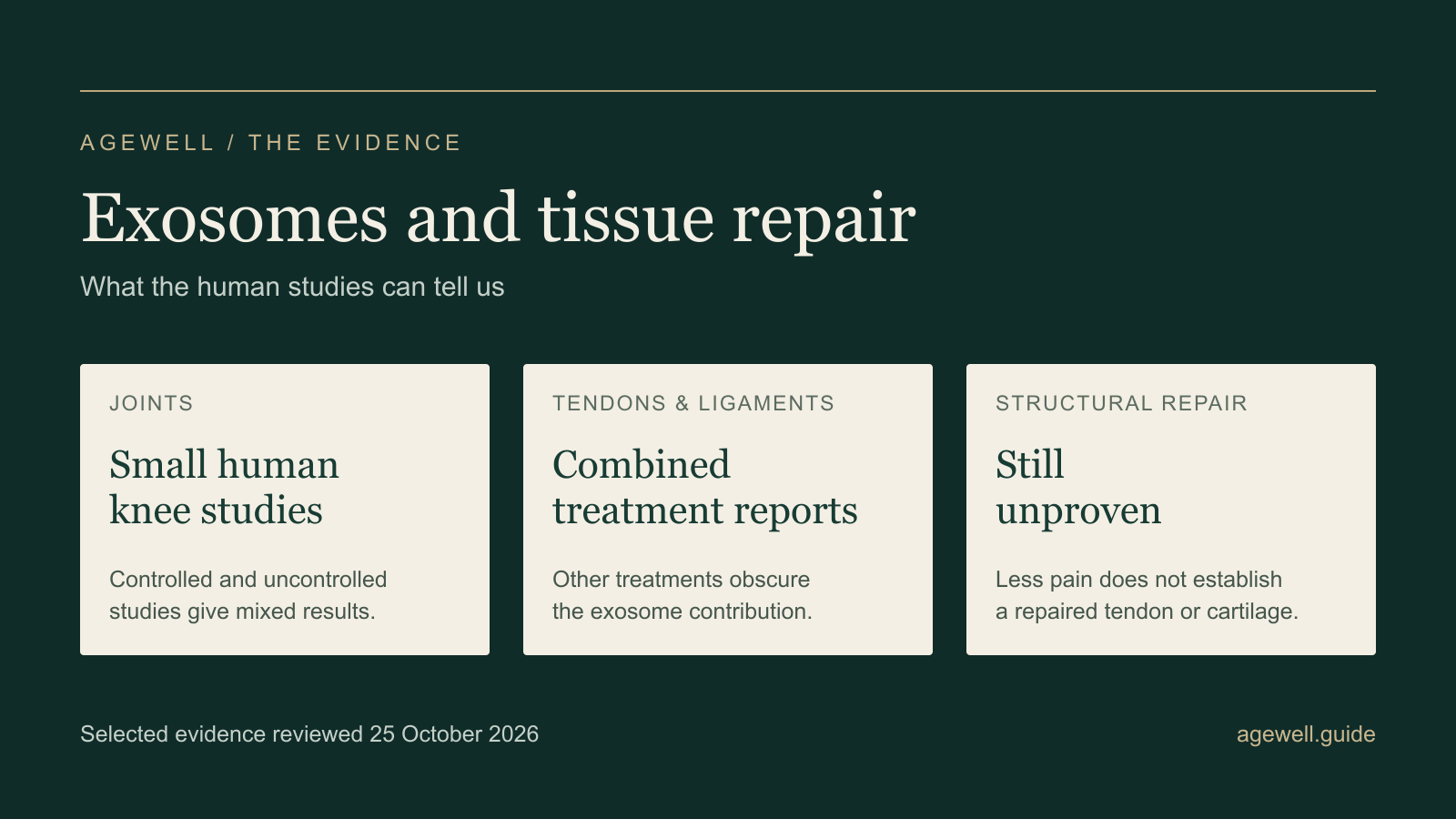
Exosome injections remain experimental for joint, tendon and ligament conditions. Small human studies report improvements, but a placebo-controlled knee osteoarthritis trial did not show a statistically significant benefit over saline. Current evidence does not establish reliable cartilage regrowth or repair of a torn tendon or ligament. There are no FDA-approved exosome products.
Agewell verdict
An exosome procedure should be assessed as an investigational treatment with a specific product, diagnosis and follow-up plan. We would not pay for a promise of cartilage regrowth, a repaired ACL or a guaranteed return to sport on the evidence reviewed here.
My experience with PRF and exosomes
In summer 2025, I received three exosome treatments and five PRF treatments across four painful areas at SLS in Stockholm. I paid 29,500 SEK for the course and noticed a major improvement after treatment.
Because the course combined PRF and exosomes, I cannot separate the effect of each treatment. The price describes my own course in 2025; it is not a current quote. The SLS profile linked below contains the full account.
Exosomes are tiny membrane-bound particles released by cells. They belong to a broader group called extracellular vesicles, or EVs, and can carry proteins, lipids and RNA that affect other cells. Researchers are studying whether these signals can alter inflammation and tissue repair.
Exosomes are a particular EV subtype formed inside cells. A small particle size alone does not establish that a preparation contains exosomes. The International Society for Extracellular Vesicles recommends using broader EV terminology when that origin has not been demonstrated. We retain the term used by each study. [1]
A clinic offering “exosomes” may be using a preparation derived from umbilical cord, placental, amniotic or other tissue. Cell source, processing, purity, storage and biological activity can differ. A result from one preparation cannot establish the effectiveness of another product with the same label.
The human evidence for knee osteoarthritis
Selected evidence reviewed on 25 October 2026. Study design and tissue type determine which claims a paper can support.
Knee osteoarthritis has more published human exosome and EV research than a specific ligament tear. The studies below ask different questions and use different products. Their results should not be pooled into a single clinic success rate.
The clearest controlled comparison in this set is Bolandnazar and colleagues’ 2024 trial. Each participant had osteoarthritis in both knees: one received placental MSC-derived EVs and the other saline. Of 31 people enrolled, 29 were analysed. Pain, function and MRI outcomes did not differ significantly between treatments at the reported follow-ups. That finding applies to this preparation and protocol; it cannot rule out every future EV treatment. [2]
Published human knee studies reviewed in October 2026
Study
People and design
Result and limit
Bolandnazar et al., 2024 [2]
31 enrolled; 29 analysed. EVs in one knee, saline in the other.
No significant added benefit for pain, function or MRI outcomes. Small study of one protocol.
Wang et al., 2025 [3]
41 people, 45 knees. Three active dose groups; no placebo group.
Symptoms improved. Dose randomization does not establish benefit against no treatment or placebo.
Yokota et al., 2026 [4]
29 people, 33 knees. Retrospective series; six injections.
Improvement reported through 12 months. No control group.
Courtney et al., 2026 [5]
47 people, 51 knees. Retrospective series; two EV products.
Better knee scores in available follow-up data. Missing data, mixed products and no control group.
People and knees are different denominators. These are selected studies, not a meta-analysis. Source numbers refer to the linked papers below.
Why the positive studies do not settle whether it works
The 2025 Wang paper describes a randomized, double-blind study, but all three groups received active injections at different doses. The authors acknowledge the absence of a placebo control. They also report incomplete MRI follow-up. The study can inform further research into dosing; it cannot separate the injection’s effect from other reasons symptoms might change. [3]
Yokota and colleagues reported improvement in a small series followed for 12 months. Courtney and colleagues’ October 2026 report had complete six-week paired scores for only 33 of 47 patients. Neither included a control group. Improvements after treatment are observations; determining what caused them requires a comparison that accounts for expectations, rehabilitation and changes in symptoms over time. [4, 5]
Those limits also prevent a defensible answer to “How long do exosomes last?” A follow-up visit at 12 months does not show that the product caused a benefit lasting 12 months. There is no established duration or repeat-treatment schedule that can be applied across exosome products.
Exosomes for tendon injuries and tendinopathy
Tendons connect muscle to bone. Tennis elbow, Achilles tendinopathy and rotator cuff disease involve different tendons, loading patterns and types of damage. A study of knee arthritis cannot establish that an injection treats any of them.
Human tendon reports do exist. In a 2025 clinic series by Torbjörn Ogéus, 122 of 608 patients were grouped under tendinopathy or ligament injuries. These patients received exosomes alongside platelet-rich fibrin and albumin-PRF preparations, often using both intravenous and local administration. The report recorded satisfactory relief in 107 of the 122 patients. [6]
That number describes the clinic’s combined treatment and subjective outcome category. There was no untreated or placebo comparison, follow-up was inconsistent, and tendon and ligament diagnoses were grouped together. It cannot tell a patient the chance that exosomes alone will repair an Achilles tendon or resolve tennis elbow.
A registered study of EV injections for lateral epicondylitis, NCT07111325, had no results posted when checked on 25 October 2026. A trial registration shows that research is planned or underway; it supplies no treatment result. [7]
Exosomes for ligament tears, ACL injuries and meniscus damage
Ligaments connect bone to bone and help stabilize joints. The meniscus is fibrocartilage within the knee. These structures are frequently grouped together in regenerative-treatment advertising, but pain relief, ligament stability and meniscus healing are different outcomes.
Researchers have tested exosome preparations in injured animal ligaments. For example, a 2024 experiment examined how changing the conditions used to grow the source cells altered exosome RNA and healing responses in rat ligaments. That work helps explain why manufacturing choices may affect a product’s behavior. It does not establish that a human ACL tear will heal after an injection. [8]
The mixed human clinic report above also does not establish recovery of ligament strength, a healed complete tear or a safe return to pivoting sport. A registered meniscus EV study, NCT05261360, had no posted results and an unknown recruitment status when checked. Its estimated dates should not be presented as completed evidence. [9]
For an injured knee that gives way, ask the treating specialist to explain the structural diagnosis, rehabilitation options and whether surgery is indicated. An exosome proposal needs evidence for that injury and outcome, rather than a general claim about regeneration.
Can exosomes regrow cartilage?
Reliable cartilage regeneration in people has not been established by the studies reviewed here. Pain scores and tissue structure must be assessed separately. A person may feel better without demonstrating new cartilage.
The placebo-controlled 2024 knee study found no significant MRI advantage. Wang’s 2025 pilot reported imaging changes in a subset, but lacked a placebo group and complete MRI follow-up. Another 2025 series of 114 hip and knee patients reported symptom changes and increased ultrasound-measured knee cartilage thickness after exosomes combined with PRF. It also lacked a control group. [2, 3, 10]
These reports justify testing the hypothesis in better trials. They do not establish that a commercial injection rebuilds durable, load-bearing cartilage, prevents joint replacement or restores a joint to its earlier condition. A clinic making one of those claims should provide a controlled study of the product it proposes to use.
Exosomes, PRP, PRF and stem cells
PRP, or platelet-rich plasma, is prepared from a patient’s blood by concentrating platelets. PRF, or platelet-rich fibrin, is another blood-derived preparation with a fibrin matrix. Stem-cell treatments administer cells; EV treatments administer particles released by cells. Combining them makes it harder to identify which component contributed to an outcome. [1, 10, 11]
There is no head-to-head evidence in the studies reviewed here establishing that exosomes outperform PRP for your joint or tendon diagnosis. PRP has a larger clinical literature, but its results vary by condition and preparation. The AAOS patient guide distinguishes the evidence for knee arthritis and certain chronic tendon problems from less established uses. [11]
Particles released by cells; the source and preparation vary.
Exact product, source, characterization, dose and evidence for your diagnosis.
PRP
A preparation from your blood with concentrated platelets.
Preparation method and evidence for the specific joint or tendon condition.
PRF
A blood-derived preparation containing fibrin and platelets.
Whether it is used alone or with other products.
Stem-cell treatment
Cells, with substantial differences between sources and processing methods.
Exact cell product, regulatory status and condition-specific evidence.
These labels do not establish equal effectiveness, quality or regulatory status.
Safety and approval status
The FDA’s consumer alert, checked on 25 October 2026, states that there are no FDA-approved exosome products. It also states that these products have not been approved for orthopedic conditions, including osteoarthritis and tendonitis. A clinic’s availability, a laboratory registration or a clinical-trial listing does not establish product approval. [12]
In 2019, the FDA reported serious adverse events in patients treated with unapproved products marketed as containing exosomes. That notice does not give a risk rate for every product or route of administration. Equally, small studies reporting no serious events cannot exclude rare complications or establish long-term safety. [13]
Ask about sterility, donor screening where applicable, batch testing, storage, injection-related complications and how adverse events are recorded. “Cell-free” describes the preparation; it does not establish that it is risk-free.
Outside the United States, verify the exact product, indication and treatment setting with the relevant national regulator. FDA status does not determine whether a procedure is lawful in Sweden, Spain or another country. A licensed clinic and an authorized product are separate checks.
What to ask before paying for treatment
Ask for a written proposal that names the diagnosis, product, manufacturer, tissue source, route, dose and number of sessions. It should identify any added PRP, PRF, cells or other treatments. A particle count alone will not tell you whether two products have comparable biological activity.
Request the human study supporting that exact use. Check who was treated, whether there was a control group, what changed and how many patients were lost to follow-up. Ask whether the clinic is offering treatment within an authorized clinical trial and, if so, request its regulatory and ethics documentation. In the US, the FDA advises asking the investigator for the IND number and the relevant FDA communication. [13]
Agree on a rehabilitation plan, a measure of improvement and a review date before the first injection. The written price should cover the full proposed course, consultations, imaging where indicated and follow-up. Ask who manages complications after you return home and what would lead the clinician to stop further injections.
Established care still needs a place in the plan
For osteoarthritis, NICE recommends exercise tailored to the person, with weight management where appropriate. For midportion Achilles tendinopathy, the 2024 clinical practice guideline recommends tendon-loading exercise as first-line treatment, with the plan adapted to the individual. These recommendations apply to the conditions named; they are not a generic exercise prescription for an undiagnosed tear. [14, 15]
An experimental injection should not displace assessment of the injury or a treatment plan with better supporting evidence. Bring the clinic’s proposed product and its cited study to an independent orthopedic or sports-medicine clinician before committing to a course.
How we assessed the evidence
This is a focused editorial review checked on 25 October 2026, covering musculoskeletal use rather than cosmetic treatment. We prioritized original human studies, trial records, research standards and regulator guidance. It is not a systematic review or a treatment recommendation.
We separated controlled studies from uncontrolled series, patient counts from treated knees, symptom changes from structural healing, and exosome-only protocols from combined treatments. Animal findings supply research context. Registered trials without results supply no efficacy evidence.
Written by David Persson, Agewell’s founder, who has received exosome and PRF treatment. He is not a physician. No medical reviewer is credited for this article. There are no treatment-booking or affiliate links in this guide.
FAQ
Do exosomes work for knee osteoarthritis?
Some small studies report improvement, but a placebo-controlled trial did not show a statistically significant benefit from its EV preparation over saline. Products and protocols differ. Clinical benefit is not established across exosome treatments. [2–5]
Can exosomes repair a torn tendon or ligament?
The evidence reviewed here does not establish that exosome injections reliably repair a torn human tendon or ligament. Animal studies and uncontrolled reports of combined treatments cannot determine the chance of structural healing or a safe return to sport. [6, 8]
Are exosomes better than PRP?
The studies reviewed here do not establish that exosomes outperform PRP. The comparison needs the exact diagnosis and preparation. Results after exosomes plus PRF cannot identify the effect of exosomes alone. [10, 11]
How long does an exosome injection last?
There is no established duration of benefit that applies across exosome products. A small study reporting improvement at 12 months without a control group cannot establish that the injection caused a year-long benefit. [4]
Are exosome injections FDA-approved?
No. The FDA consumer alert checked on 25 October 2026 states that no exosome products are FDA-approved. It specifically includes orthopedic conditions among uses without approval. [12]